
⚖️ Unbiased Comparison
📅 Updated for 2026
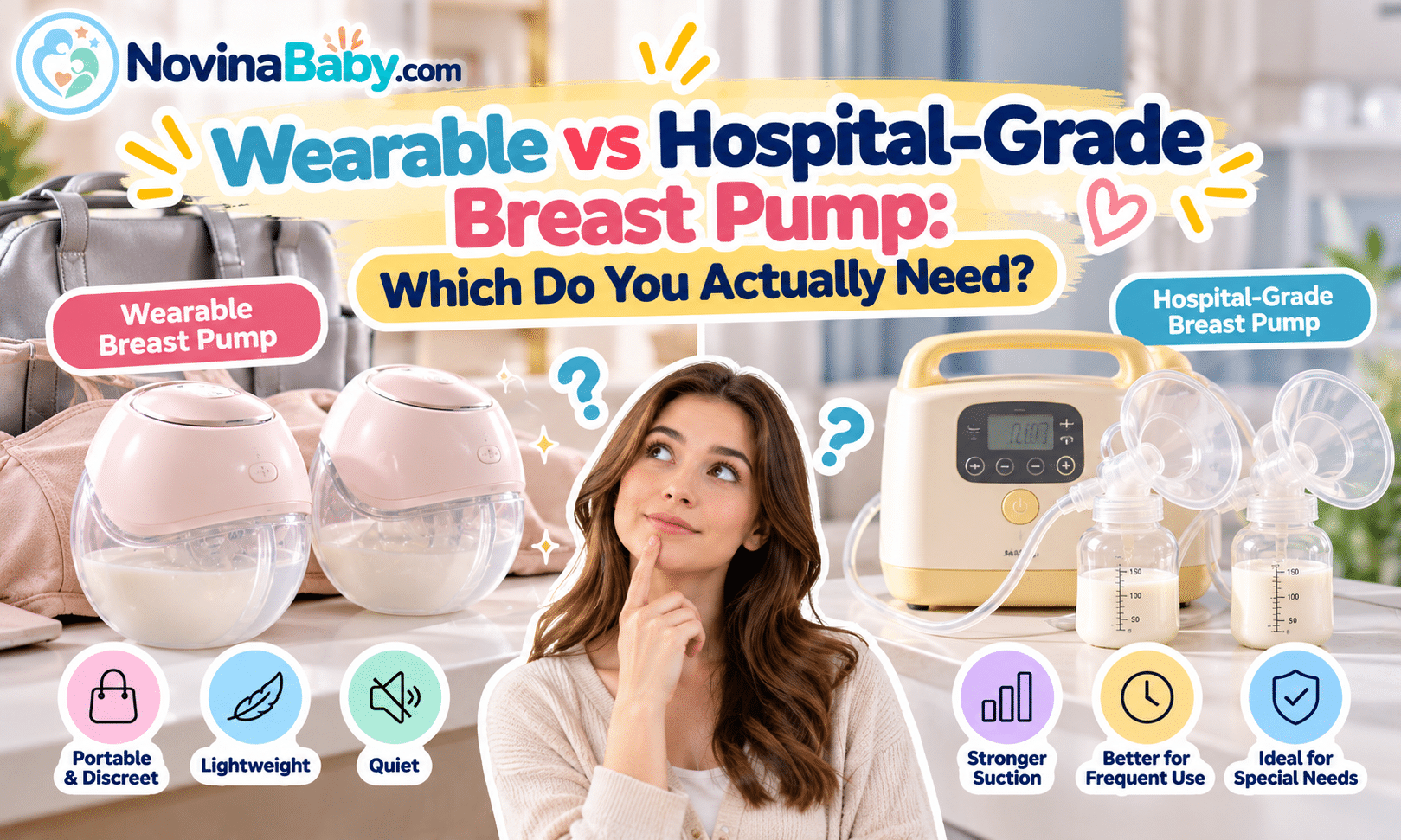
Wearable vs Hospital-Grade Breast Pump – Building your baby registry can quickly become overwhelming, especially when it comes time to choose a breast pump.
On one hand, you see Instagram influencers effortlessly making breakfast and folding laundry with discreet, wire-free cups tucked inside their bras.
On the other hand, seasoned mothers and lactation consultants insist that a heavy, wall-plugged machine with long plastic tubes is the only way to guarantee a massive freezer stash.
The debate of wearable vs hospital grade breast pump is the biggest dilemma modern mothers face.
The truth is, neither pump is objectively “better”—they simply serve two completely different stages of your breastfeeding journey.
Before you spend hundreds of dollars, let’s break down the mechanics, the pros and cons, and exactly which type of pump matches your lifestyle.
What is a Hospital-Grade Breast Pump?
The term “hospital-grade” isn’t actually regulated by the FDA, but it universally refers to a heavy-duty, desktop pump designed with a robust, highly durable motor.
These pumps (like the Medela Symphony, Spectra S1, or NCVI 8782) are designed to be used by multiple users safely because they feature a strict “closed system” that prevents milk from ever touching the motor.
They are tethered to plastic tubing and collection bottles that hang from your chest like a traditional milking machine.
What is a Wearable (Hands-Free) Breast Pump?
A wearable breast pump represents the latest evolution in lactation technology.
These devices (like the Elvie, Willow, or Momcozy) contain the motor, the flange, and the milk collection cup all within one compact, semi-spherical unit.
You simply slip them inside your nursing bra, turn them on via an app or a button, and pump completely hands-free without being tethered to an outlet or dealing with dangling tubes.
The Ultimate Showdown: Pros & Cons
Let’s look at how these two technologies stack up against each other across the most important categories.
Can You Use a Wearable Pump Exclusively?
This is the most critical question in the wearable vs hospital grade breast pump debate.
For the first 4 to 6 weeks postpartum, your body is relying entirely on strong, frequent stimulation (either from a baby or a powerful pump) to understand how much milk it needs to produce daily.
Because wearable pumps have smaller motors and slightly weaker suction profiles, they often leave a small amount of milk behind in the breast.
If you use a wearable exclusively during this crucial early window, your brain might register that leftover milk as a signal to stop producing as much, leading to a devastating drop in your overall supply.
Therefore, most lactation consultants advise using a hospital-grade pump for the first 6 weeks to establish your supply, and then introducing a wearable pump later when you return to work or need a break.
Frequently Asked Questions (FAQ)
Do I actually need to buy both types of pumps?
While not strictly necessary, many exclusive pumpers end up owning both. They use the hospital-grade pump for their primary morning and night sessions to ensure complete emptying, and use the wearable pump for daytime sessions at work or while commuting.
Are there any hybrid pumps that do both?
Yes! Brands like Pumpables (Genie Advanced) or the Spectra S9 offer small, highly portable motors that you can clip to your pants. You still have to deal with tubes, but you get near-hospital-grade suction with the mobility to walk around your house.
Will my insurance cover a wearable breast pump?
In the US, most insurance plans will fully cover a traditional desktop pump (like Medela or Spectra). For premium wearables like Willow or Elvie, insurance usually considers them an “upgrade,” meaning they might cover a portion of the cost, but you will have to pay the remaining balance out of pocket.
Ready to Choose Your Perfect Pump?
Now that you understand the crucial differences in the wearable vs hospital grade breast pump debate, it is time to look at the top-performing models in each category. We’ve rigorously tested the market for the strongest hospital-grade motors and the most discreet smart wearables.