
⏰ Sleep Training Methodology
📅 Updated for 2026
When to Start Using an OK to Wake Clock – If you survived the newborn year, conquered the 4-month sleep regression, and successfully transitioned your baby into a crib, you probably thought your sleep deprivation days were finally behind you.
Then your sweet baby turns two years old, transitions into a big-kid toddler bed, and suddenly greets you at your bedroom door every single morning at 5:00 AM sharp—bright-eyed, bushy-tailed, and ready to start the day.
For exhausted parents, early morning wakings (anything before 6:00 AM) are a brutal psychological test. Toddlers do not understand digital numbers or clock faces; telling a 2-year-old, “It’s only 5:00 AM, go back to sleep for an hour,” is entirely useless because they have zero concept of linear time.
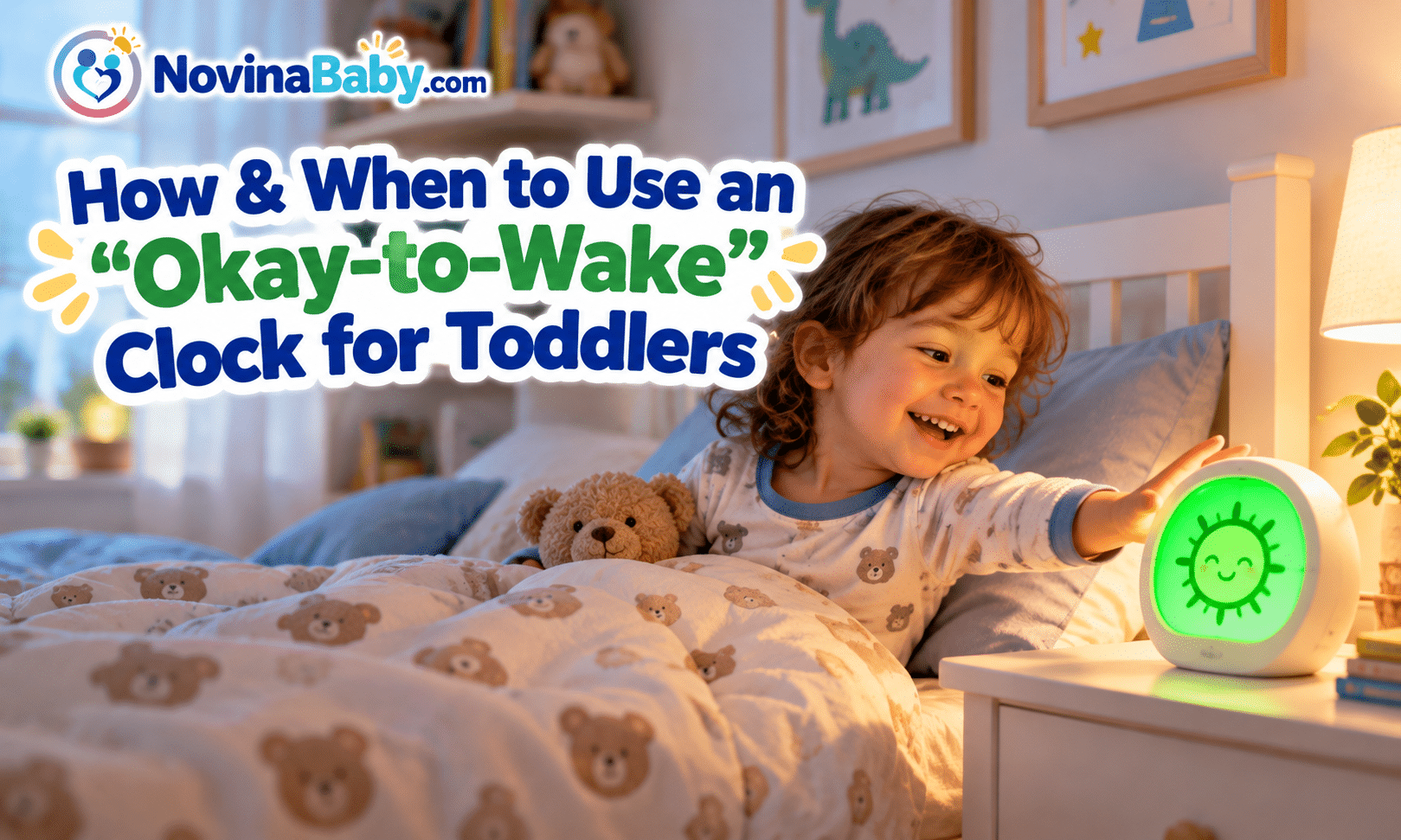
Enter the “Okay-to-Wake” clock (also known as a toddler sleep trainer). By replacing abstract numbers with intuitive visual color cues—such as red for sleep and green for wake—these devices give toddlers an independent framework to regulate their mornings.
When is the right age to introduce one? How do you set realistic times without driving your child crazy? Let’s master the methodology behind toddler sleep training clocks.
When Is a Child Ready for an “Okay-to-Wake” Clock?
Many parents buy an Okay-to-Wake clock the exact night they transition their toddler into an open bed—often around 18 months—expecting the glowing light to magically keep the child confined to their room.
Unfortunately, developmental timing matters. According to pediatric sleep consultants, most children are developmentally ready to understand the cause-and-effect concept of a sleep training clock between 2 and 3 years old (though advanced toddlers around 18 to 24 months can grasp a basic on/off light cue).
| Child’s Age Stage | Cognitive Readiness & Comprehension | Recommended Sleep Cue Strategy |
|---|---|---|
| Months 12 to 18 (Late Infancy) | Cannot understand conditional rules yet (“If light is red, stay; if green, go”). Object permanence is forming, but impulse control is zero. | ❌ Skip complex clocks. Use a simple, silent 100% pitch-black room with white noise. |
| Months 18 to 24 (Early Toddler) | Understand simple binary commands (“Light on = time to get up”). Can learn through physical role-playing. | ⚠️ Basic On/Off Light Cue (Turn the light on manually via app or smart plug when morning arrives). |
| Years 2 to 4+ (Core Toddler & Preschool) | Fully capable of grasping color symbolism (Red vs. Green) and following multi-step rules. | ✅ Perfect window for a dedicated color-changing sleep training clock (Hatch Rest, Mella, or Zazu Sam). |
The Golden Rule: Red Means Sleep, Green Means Go
When programming your smart sound-and-light hub (such as the Hatch Rest) or dedicated sleep trainer (like LittleHippo Mella or Zazu Sam), color assignment is crucial. You must use wavelengths that respect circadian biology:
- During Sleeping Hours (Red / Amber): As we proved in our scientific guide on red light vs blue light for baby sleep, deep red (620–750 nm) or warm amber light preserves 100% of melatonin secretion. Set your clock to glow in a soft red or sunset orange from bedtime until your desired morning wake time so it doubles as a safe overnight night light.
- At Wake-Up Time (Green / Yellow / Sun Icon): When the target wake time arrives, the clock should dynamically shift to a bright, cheerful color—traditionally green (“Go!”) or a glowing yellow sun icon. This sharp visual contrast tells the toddler immediately that the night is officially over and they are allowed to get out of bed.
The 4-Step Success Plan to Introduce the Clock (Without Tears)
If you plug an Okay-to-Wake clock into your toddler’s room, set it for 7:00 AM, and expect them to magically obey it on night one without any preparation, you will likely be disappointed. Toddlers hate sudden rules.
Use this proven 4-step introduction plan during the weekend *before* you launch the clock.
Troubleshooting: Why Your Okay-to-Wake Clock Might Be Failing
If you’ve been using a sleep training clock for a week and your toddler is still pounding on your door at 4:45 AM, check for these three common pitfalls:
- The Bedroom Is Too Bright at Dawn: If your toddler’s bedroom windows lack heavy blackout shades, natural sunlight flooding the room at 5:00 AM overrides the clock’s red light, signaling their brain that daytime has arrived. Install tight blackout curtains so the room stays dark until the clock turns green.
- Bedtime Is Too Late (Overtiredness): Counterintuitively, putting a toddler to bed too late (e.g., 9:00 PM) frequently causes earlier morning wake-ups due to stress cortisol spikes. Shift their bedtime 30 minutes earlier.
- Inconsistent Parent Follow-Through: If the red light is still glowing at 5:30 AM but you open the door and pull your toddler out of bed anyway, you teach them that the clock rules don’t matter. You must hold the boundary (using gentle verbal reminders or returning them to bed) until the color actually changes.
When to Start Using an OK to Wake Clock (FAQ)
Can I use an Okay-to-Wake clock for nap times too?
Yes! Most smart sound-and-light hubs and app-controlled clocks allow you to program a daytime nap schedule. Set the clock to glow red during nap time and switch to green after 60 to 90 minutes to signal that “quiet rest time” is over.
What if my toddler is still in a crib—can I still use a sleep training clock?
Absolutely. In fact, introducing the clock while they are still safely contained in a crib is a brilliant strategy. It builds the association between the green light and morning time for a few weeks before you ever transition them to an open big-kid bed.
Should the clock play white noise all night while the red light is on?
Yes, combining continuous pink or brown noise with the dim red light creates a complete sensory sleep environment. Just ensure the volume stays below 50 decibels and the unit is positioned at least 7 feet away from the bed to protect their hearing.
What features should I look for when buying a toddler sleep training clock?
Look for parental control locks (so curious toddlers can’t change the buttons), adjustable brightness settings, customizable color palettes (pure red and green), Wi-Fi/app connectivity (so you can adjust times remotely from your phone if they wake up early), and battery backup in case of power outages.
Get Your Mornings Back With a Top-Rated Sleep Trainer
Stop losing sleep to 5:00 AM toddler wake-ups. Equip your child’s room with a smart sound-and-light hub that teaches them when it’s truly time to start the day. Explore our hands-on reviews of the best Okay-to-Wake clocks and smart nursery machines of 2026.
Read Our Ultimate Guide on the Best Baby Night Lights of 2026