
🛡️ CPSC Outlet Safety Aligned
📅 Updated for 2026
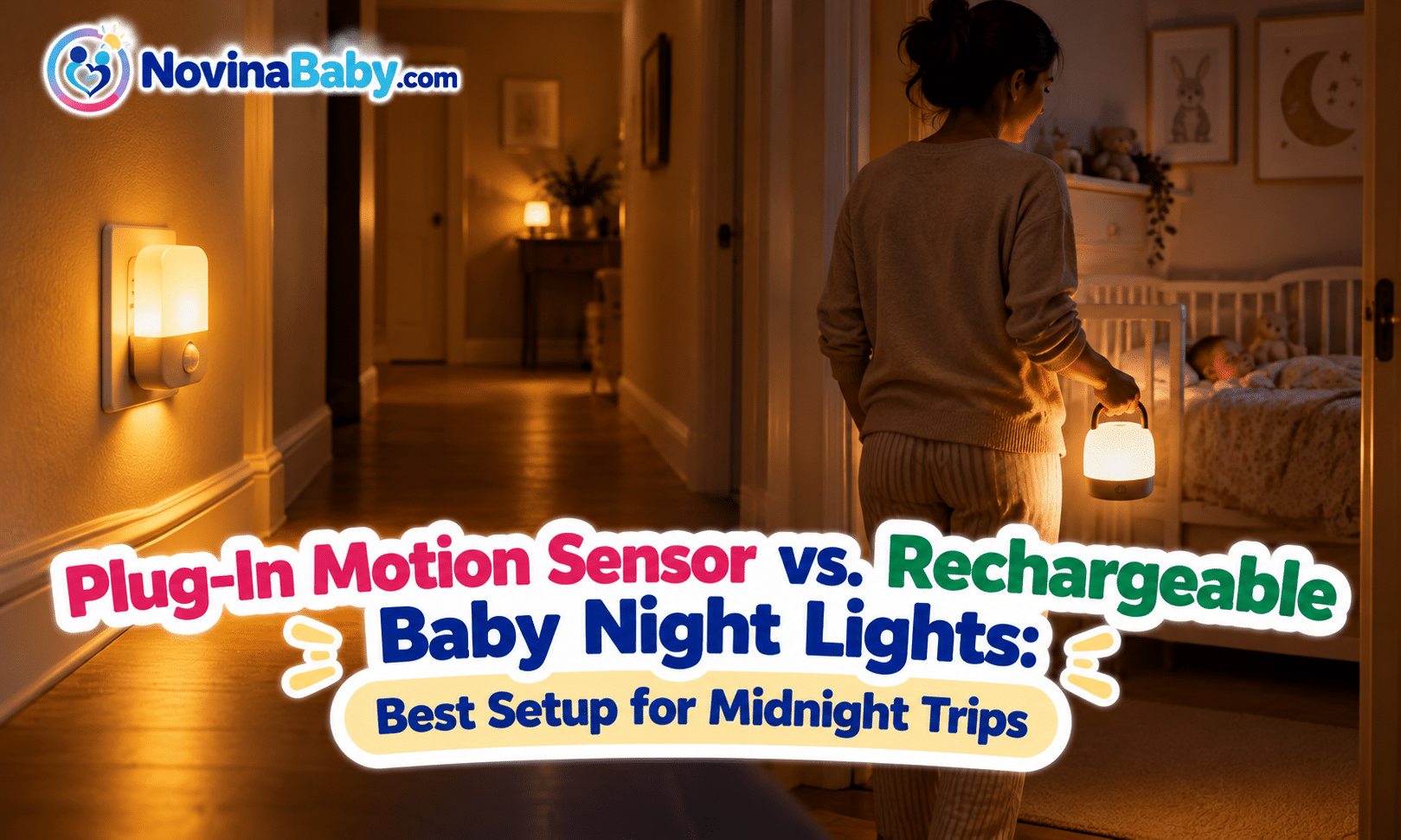
Motion Sensor vs Rechargeable Baby Night Light – When you are preparing for a new baby, you naturally focus all your attention on the lighting inside the nursery. But what happens when you actually have to leave the bedroom at 2:30 AM?
Whether you are walking down a dark hallway to grab a bottle from the kitchen fridge, heading to the nursery to change a blowout, or simply navigating to the bathroom, middle-of-the-night trips are fraught with hazards. If you turn on the bright overhead hallway lights, you instantly destroy your night vision and chemically suppress your (and your baby’s) melatonin. If you try to navigate in the dark, you risk tripping over a pet, a stray shoe, or a rogue toddler toy while holding your fragile newborn.
Creating a safe, low-stimulation path through your house requires a strategic mix of hardware. In the debate of a motion sensor vs rechargeable baby night light, there is no single winner—because they are designed to solve entirely different 3:00 AM problems.
Let’s break down the mechanical differences, uncover why motion sensors belong nowhere near your crib, and help you map out the ultimate “Midnight Trip” lighting setup for your home.
Quick Comparison Matrix: Motion Sensor vs. Rechargeable Touch Light
Before mapping out your house, here is exactly how these two distinct lighting technologies compare across functionality, power, and safety.
| Feature / Metric | Plug-In Motion Sensor Night Light | Cordless Rechargeable Touch Light |
|---|---|---|
| Trigger Mechanism | Passive Infrared (PIR) sensors detect body heat movement within a 10–15 foot radius. | Physical human touch (tapping the top, squeezing the silicone shell, or pressing a button). |
| Primary Function | Hands-free pathway illumination (Hallways, Stairs, Kitchens). | Precision task lighting (Nursing, Diaper Changes, Reading). |
| Power Source | Plugs directly into AC wall outlet (never needs charging). | Internal lithium-ion battery (requires USB-C charging every 1-3 weeks). |
| Mobility | Zero. Confined to exactly where your wall outlets are located. | 100% Mobile. Carry it from the bed to the changing table. |
| Nursery Suitability | Terrible. Will accidentally wake the baby if parents toss and turn or a pet walks by. | Perfect. Stepless dimming ensures it is never brighter than necessary. |
1. The Plug-In Motion Sensor: The “Hands-Free” Hallway Guide
Motion sensor night lights (like those from eufy, Vont, or GE) use Passive Infrared (PIR) technology. They detect the thermal energy of a warm body walking across their field of view and instantly turn on for a preset duration—usually 30 to 60 seconds—before fading back to black.
Why They Rule the Hallways
When you are walking out of your bedroom holding a crying, squirming newborn in both arms, you do not have a free hand to fumble for a wall switch. Motion sensors act as a hands-free concierge. As you step into the hallway, a soft pool of light illuminates your path, guiding you safely past the top of the stairs or toward the kitchen.
🚨 Why You Should NEVER Put a Motion Sensor in the Nursery
It is tempting to put a motion sensor near the crib so the room lights up automatically when you walk in. This is a massive mistake.
PIR sensors are highly sensitive. If you are room-sharing and you roll over in your adult bed, the sensor will trigger. If the family cat wanders into the nursery, the sensor will trigger. If your baby stands up in their crib, the sensor will trigger. Every false trigger blasts the room with sudden light, triggering the baby’s visual orienting reflex and destroying their sleep cycle. Keep motion sensors strictly in transit zones.
The Pros of Motion Sensors 👍
| The Cons of Motion Sensors 👎
|
2. The Rechargeable Touch Light: The Precision Nursery Tool
A rechargeable touch light (or “tap light”) is a cordless, battery-powered silicone or plastic dome that sits on a nightstand or charging coaster. To turn it on or adjust the brightness, you simply tap the top of the light with your hand.
As we detailed in our broader comparison of a portable tap light vs smart sound machine, the cordless tap light is the undisputed champion of the 3:00 AM diaper change. It provides targeted, localized light exactly where you place it.
Why It Dominates the Bedroom
When you are in the nursery, you want complete control over when the light turns on and how bright it gets. A high-quality tap light features stepless dimming and a memory function. If you dimmed it to a 2% red glow during the 11:00 PM feed, it will turn back on at that exact 2% red glow when you tap it at 3:00 AM—meaning no sudden flashes of blinding white light.
Because it is cordless, you can pick it up from your bedside table, carry it like a lantern to the bassinet to check on a grunt, and set it down on the changing pad to illuminate a messy diaper blowout while keeping the baby’s face safely in the shadows.
The Pros of Rechargeable Touch Lights 👍
| The Cons of Rechargeable Touch Lights 👎
|
The Ultimate 3 AM “Midnight Trip” Setup
To navigate the exhausting newborn months seamlessly, the best strategy isn’t choosing between a motion sensor vs rechargeable baby night light—it is deploying both technologies in their respective zones. Here is the ultimate house-wide setup:
Motion Sensor vs Rechargeable Baby Night Light (FAQ)
Are amber motion sensor lights better than white ones for the hallway?
Yes, drastically. As we proved in our clinical breakdown of red light vs blue light for baby sleep, short-wavelength white and blue light suppresses melatonin immediately upon hitting your retina. Walking through a bright white hallway at 3:00 AM signals your brain to wake up. An amber motion sensor (under 2700K) allows you to see the stairs clearly without disrupting your sleep hormones.
How do I babyproof low plug-in motion sensors once my baby crawls?
Once your baby is mobile (around 6 to 9 months), they will try to pull plug-in lights out of baseboard outlets, exposing the live electrical prongs. To babyproof, you must either replace the plug-ins with screw-in LED outlet cover plates (like SnapPower GuideLights) or enclose the plug-in light inside a vented, hard-plastic childproof outlet box.
Can I use my smartphone flashlight instead of buying a touch light?
Using your smartphone flashlight is heavily discouraged for two reasons: First, the LED flash is intensely bright and casts harsh, high-contrast shadows that overstimulate a baby. Second, picking up your phone inevitably leads to checking notifications or staring at the bright screen, which makes it significantly harder for you to fall back asleep after the feed.
Will hallway motion sensors trigger if I leave the nursery door open?
They shouldn’t, provided they are angled correctly. PIR motion sensors require a direct line of sight to detect sweeping thermal motion. If the sensor is plugged into a wall flush with the nursery doorframe, it will only trigger when someone physically steps out into the hallway path.
Build Your Perfect 3:00 AM Navigation System
Combining a portable tap light for the bedroom with warm amber motion sensors for the hallway guarantees a safe, low-stress environment for every midnight feed. We have rigorously evaluated the top-rated CPSC-certified lighting systems to help you curate your ideal, sleep-friendly setup.
Read Our Ultimate Guide on the Best Baby Night Lights of 2026