
⚖️ Unbiased Comparison
📅 Updated for 2026
Manual vs. Electric Breast Pumps – When you are preparing for a new baby, the sheer volume of feeding gear you are told to buy can feel completely overwhelming. At the top of that expensive list is the breast pump.
You have likely seen targeted ads for high-tech, double electric smart pumps that cost hundreds of dollars[cite: 11]. But then, your best friend swears that a simple, $15 manual silicone pump saved her breastfeeding journey.
This leaves new mothers staring at their registry, paralyzed by the ultimate question: in the battle of the manual vs electric breast pump, which one do you actually need?
The short answer? It depends entirely on your lifestyle, your budget, and how often you plan to be away from your baby.
Let’s break down the mechanical differences, the pros and cons of each type, and reveal why most lactation consultants actually recommend keeping both in your postpartum survival kit.
The Heavy Lifter: Double Electric Breast Pumps
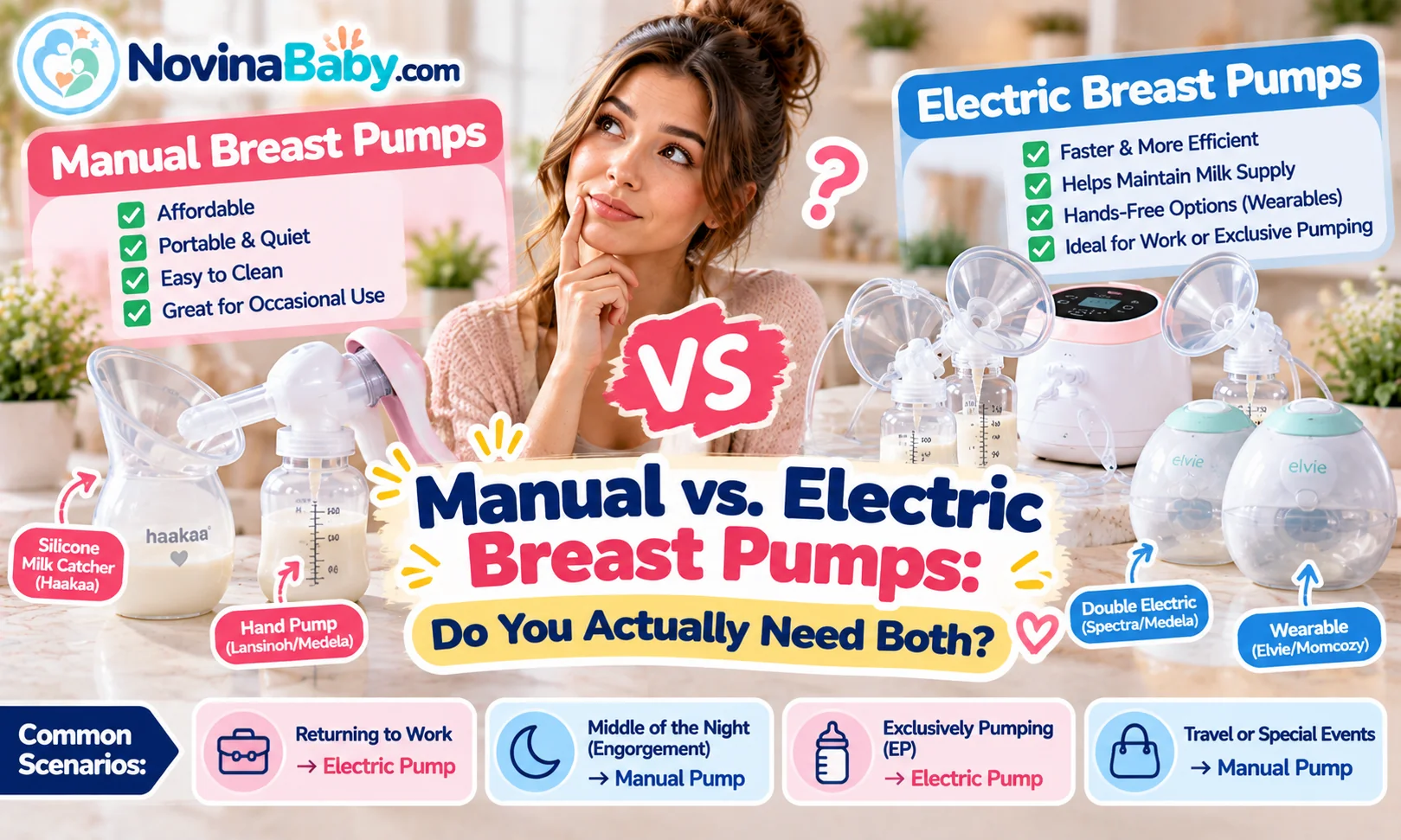
Electric breast pumps (like the Spectra S1, Medela Pump in Style, or wearables like Elvie) are powered by a motor that automatically creates and releases a vacuum seal[cite: 11, 12]. They do the physical work for you.
A “double” electric pump means you can pump both breasts simultaneously. This is the gold standard for mothers who are returning to work full-time or who are “exclusively pumping” (providing milk via bottle without nursing directly).
The Pros of Electric Pumps 👍
- Speed and Efficiency: Pumping both breasts at once takes half the time (usually 15-20 minutes total).
- Supply Protection: The strong, consistent motor is essential for triggering multiple let-downs and establishing a robust milk supply in the first 6 weeks.
- Hands-Free Options: Many modern electric pumps are wearable, allowing you to multitask[cite: 12].
The Cons of Electric Pumps 👎
- High Cost: Quality electric motors are expensive (ranging from $150 to $500).
- Tethered to Power: Unless you have a strong battery or wearable, you are tied to a wall outlet.
- Lots of Parts: They require washing multiple flanges, duckbill valves, and bottles after every session.
The Unsung Hero: Manual Breast Pumps
Manual pumps require your physical hand power to create the suction. There are two distinct types:
- The Hand Pump (e.g., Lansinoh/Medela Manual): Features a lever handle that you squeeze rhythmically to extract milk.
- The Silicone Milk Catcher (e.g., Haakaa): A one-piece silicone bulb that uses passive, continuous suction to catch leaking milk from one breast while your baby nurses on the other[cite: 11].
The Pros of Manual Pumps 👍
- Absolute Control: You control the exact speed and depth of the suction, making it incredibly effective for slowly clearing painful clogged ducts.
- Silent & Portable: Zero motor noise. Perfect for throwing in a purse or using on an airplane.
- Cheap & Easy to Clean: Usually under $30, and only consists of 1 to 3 pieces to wash.
The Cons of Manual Pumps 👎
- Hand Fatigue: Squeezing a handle rhythmically for 15 minutes is exhausting.
- Slower Extraction: Pumping one side at a time takes twice as long.
- Not for EPers: It is nearly impossible to maintain a full milk supply using only a manual pump long-term.
Scenario Comparison: Which Should You Grab?
Still on the fence regarding the manual vs electric breast pump debate? Here is a quick cheat sheet for common postpartum scenarios:
| Scenario | The Best Tool | Why? |
|---|---|---|
| Returning to a 9-to-5 Office Job | Double Electric | You need to empty both breasts quickly during short 15-minute work breaks. |
| Waking up at 2 AM with rock-hard, engorged breasts | Manual Pump (or Haakaa) | Quietly relieves the painful pressure in 2 minutes without waking the baby or setting up tubes. |
| Exclusively Pumping (EP) from Day 1 | Double Electric (Hospital-Grade) | Requires a heavy-duty motor to mimic a baby and build your baseline milk supply[cite: 11, 12]. |
| Going to a wedding for 5 hours | Manual Pump | Fits in a small purse and allows you to discreetly relieve pressure in a bathroom stall. |
The Final Verdict: Do You Actually Need Both?
Yes. If your budget allows for it, you should own both.
An electric pump is your primary daily workhorse. It is the machine that protects your milk supply and fills your freezer.
However, an electric pump can fail. The power can go out during a storm, you might forget a critical charging cable on a road trip, or a tiny silicone valve might tear at 3:00 AM.
Having a $20 manual pump in your diaper bag acts as the ultimate, foolproof insurance policy. It will save you from excruciating engorgement and painful mastitis when modern technology inevitably fails.
Frequently Asked Questions (FAQ)
Do manual breast pumps hurt less than electric ones?
Often, yes. Because you control the exact speed and strength of the squeeze, you can easily stop or adjust if it feels uncomfortable. Electric motors, especially if set to high levels with the wrong flange size, can easily cause painful blisters and bruising.
Is a Haakaa considered a breast pump?
Technically, the Haakaa is a silicone “milk catcher”[cite: 11]. It uses passive, continuous suction to draw out let-down milk while the baby stimulates the other breast. It does not actively mimic the “suck-swallow-breathe” rhythm of a baby, so it cannot be used to replace a missed feeding or build a full milk supply on its own.
Can I get a breast pump for free?
If you are in the United States, the Affordable Care Act (ACA) requires most health insurance plans to cover the cost of a breast pump. You can usually get a high-quality, double electric desktop pump completely free, and purchase a manual pump out-of-pocket as your backup.
Ready to Choose Your Perfect Pump?
Now that you know how a manual pump compliments a heavy-duty motor, it is time to choose your primary electric machine. We’ve rigorously evaluated the market for the strongest hospital-grade motors and the most discreet smart wearables.