
🩺 CDC Storage Guidelines
📅 Updated for 2026
How to Pump at Work – The end of maternity leave brings a tidal wave of emotions. Alongside the anxiety of leaving your baby in daycare, there is a looming, highly stressful logistical question: How on earth am I going to pump enough milk while sitting in a cubicle?
Trying to balance conference calls, spreadsheets, and the biological clock of your breast milk supply is an intense juggling act. Many mothers experience a devastating drop in their milk supply during their first month back at the office simply because they lack a solid routine.
However, learning exactly how to pump at work is entirely manageable when you arm yourself with the right legal knowledge, an impenetrable schedule, and the correct technology.
From understanding your federally protected rights to packing the ultimate pumping bag, here is your definitive 2026 survival guide for the working mom.
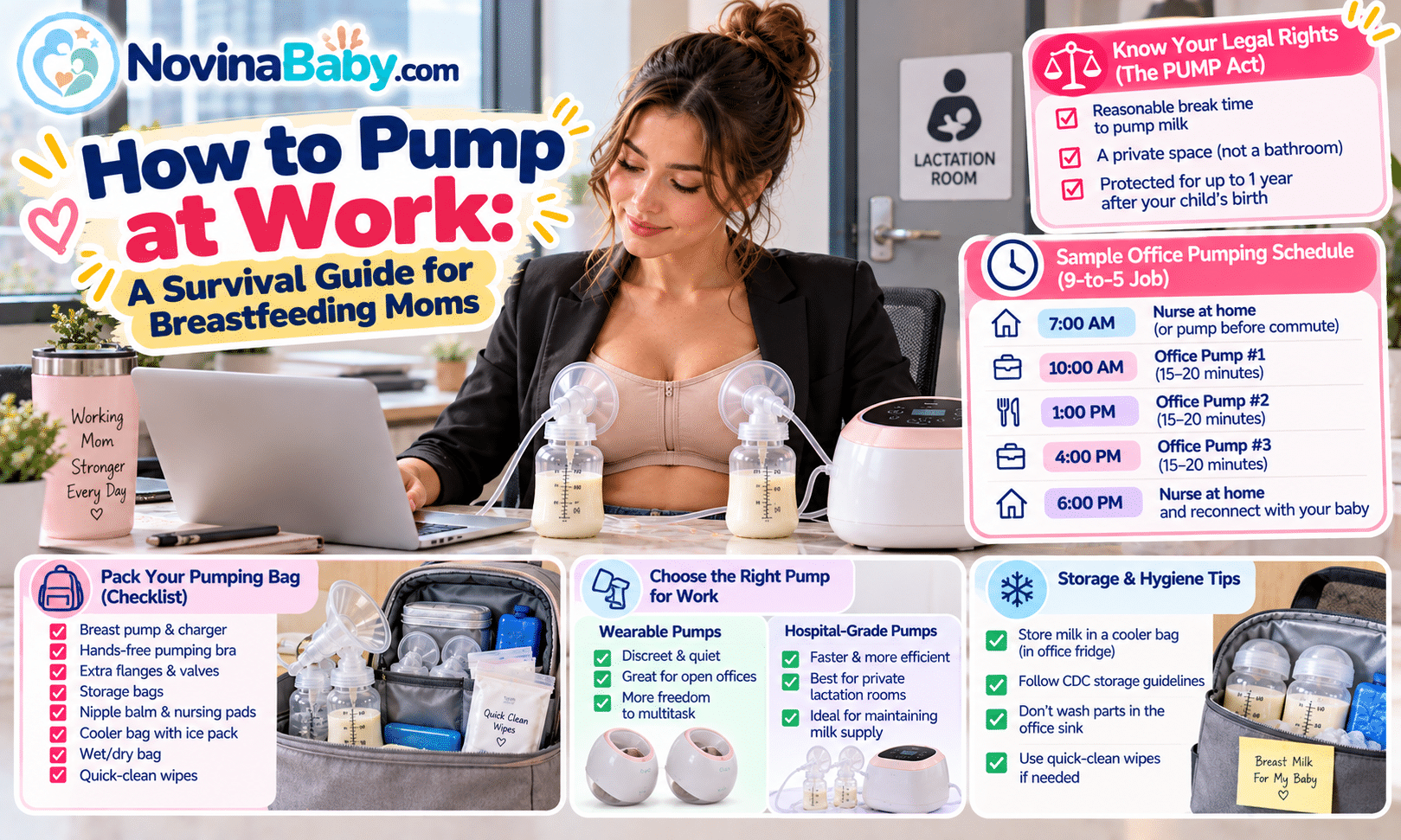
Step 1: Know Your Legal Rights (The PUMP Act)
Before you even step foot in the office, you must understand your federal protections. You do not have to hide in your car or sit on a dirty toilet to provide food for your baby.
⚖️ The PUMP for Nursing Mothers Act
Passed at the end of 2022 and fully enforced today, this federal law mandates that employers must provide nursing employees with:
- Reasonable Break Time: As much time as you need to pump milk for one year after your child’s birth.
- A Private Space: A space shielded from view and free from intrusion. It cannot be a bathroom.
Actionable Tip: Email your HR department two weeks before your return date. Ask them to reserve the lactation room on your calendar, and ensure the room has a lock, a comfortable chair, and a working electrical outlet.
Step 2: Build Your Office Pumping Schedule
To maintain your milk supply, you need to remove milk from your breasts at the exact same times your baby would normally be nursing. If you work a standard 9-to-5 job, this usually means pumping three times during the workday.
While an exclusive pumping schedule for newborns might require 8 pumps a day, an older baby (3+ months) usually allows for a more manageable office routine:
| Time | Action |
|---|---|
| 7:00 AM | Nurse your baby directly at home (or pump completely empty) right before commuting. |
| 10:00 AM | Office Pump #1 (15-20 mins). |
| 1:00 PM | Office Pump #2 (15-20 mins). Try to align this with your lunch break. |
| 4:00 PM | Office Pump #3 (15-20 mins). |
| 6:00 PM | Arrive home and nurse your baby immediately to reconnect and empty the breasts. |
Step 3: Pack the Ultimate Pumping Bag (Gear Checklist)
Forgetting a single membrane or a charging cable can ruin your entire workday. Pack your bag the night before using this foolproof checklist:
🎒 The Hardware
- Your Breast Pump (Motor & charger).
- When deciding between a wearable vs hospital grade breast pump for work, wearables (like Elvie) are best for open-office discretion, while desktop units are faster in private lactation rooms.
- A hands-free pumping bra.
💧 The Spares
- Two extra sets of flanges and duckbill valves. Knowing when to replace breast pump parts is vital—keep spares in your desk in case a valve tears mid-day.
- Breast milk storage bags.
- Nipple balm and nursing pads.
🧼 Storage & Cleaning
- Insulated cooler bag with a hard ice pack.
- A large wet/dry bag for dirty flanges.
- Quick-clean breast pump wipes (for days when you can’t access a clean sink).
Step 4: Managing Storage and Hygiene at the Office
Handling bodily fluids in a corporate environment requires a solid strategy. According to the CDC, freshly pumped breast milk can safely sit at room temperature for up to 4 hours, and can be stored in a refrigerator for up to 4 days.
The Storage Strategy: If your office has a communal fridge, place your tightly sealed bottles or milk bags inside an opaque, insulated lunchbox before putting them in the fridge to maintain privacy and prevent contamination.
The Cleaning Strategy: Do not wash your parts in the communal kitchen sink where coworkers dump coffee and soup (this is a massive bacteria risk). Instead, read our comprehensive guide on how to clean breast pump parts, which breaks down the safety of using Medela quick-clean wipes or the controversial “fridge hack” during office hours.
How to Pump at Work (FAQ)
Can I pump while working at my desk?
Yes, if you feel comfortable! Many modern moms use discreet, in-bra wearable pumps (like Momcozy or Elvie) and throw a large cardigan over their chest. You can easily type, read emails, and even sit on camera-off Zoom calls while pumping at your desk.
What should I do if my supply drops when I go back to work?
A slight dip in the first two weeks is completely normal due to stress. To recover your supply, make sure you are drinking at least 80oz of water a day, look at photos/videos of your baby while pumping to trigger oxytocin, and consider adding one “Power Pumping” session at night.
Are break times for pumping paid?
Under the federal PUMP Act, if you are completely relieved of your duties during your pump break, the employer is not required to pay you for that time. However, if you are answering emails or taking calls while pumping, you must be compensated for that time just like regular working hours.
Need the Perfect Pump for the Office?
If your current machine is too loud, too bulky, or taking too long to empty you during your short work breaks, it is time for an upgrade. We’ve rigorously evaluated the market for the quietest smart wearables and the most efficient hospital-grade motors designed specifically for working moms.