
🦠 Bacteria Prevention
📅 Updated for 2026
How to Safely Defrost Frozen Breast Milk Fast – It is the scenario every pumping mother dreads: The baby is screaming, the refrigerator is completely empty of fresh milk, and your only supply is frozen solid as a brick in the deep freezer.
In a moment of pure panic, the kitchen microwave looks incredibly tempting. Or perhaps dropping the frozen plastic milk bag directly into a pot of rapidly boiling water seems like a logical, time-saving shortcut.
If you take those shortcuts, you will permanently ruin the milk you worked so hard to pump.
Breast milk is a complex, living biological fluid. Freezing it preserves its incredible white blood cells, antibodies, and fats for up to six months. However, the process of bringing it back from a frozen state to a liquid state requires strict temperature control to prevent aggressive bacterial growth and nutritional destruction.
Understanding exactly how to defrost frozen breast milk safely is a mandatory skill for maintaining your baby’s health. Let’s break down the official CDC guidelines, the three safest thawing methods, and the confusing “24-Hour Rule” that catches every new parent off guard.
🚫 The 3 Absolute “NOs” of Thawing
Before we discuss the right way to do it, you must memorize the methods that pediatricians strictly forbid. As we noted in our guide on dangerous bottle warming mistakes, these shortcuts can cause physical harm to your baby:
- Never Use the Microwave: Microwaves heat unevenly, creating hidden pockets of boiling milk that will severely scald your baby’s throat. Furthermore, the radiation instantly destroys the milk’s immune-boosting antibodies.
- Never Use Boiling Water: Placing a frozen plastic breast milk bag into boiling water causes a massive temperature shock. The plastic bag will warp, melt, or split open, spilling your liquid gold down the drain and leaching microplastics into the milk.
- Never Thaw on the Kitchen Counter: Leaving a frozen bag of milk out at room temperature causes the outer layers of the milk to become warm while the center remains frozen solid. This uneven thawing creates a perfect, rapid breeding ground for dangerous bacteria.
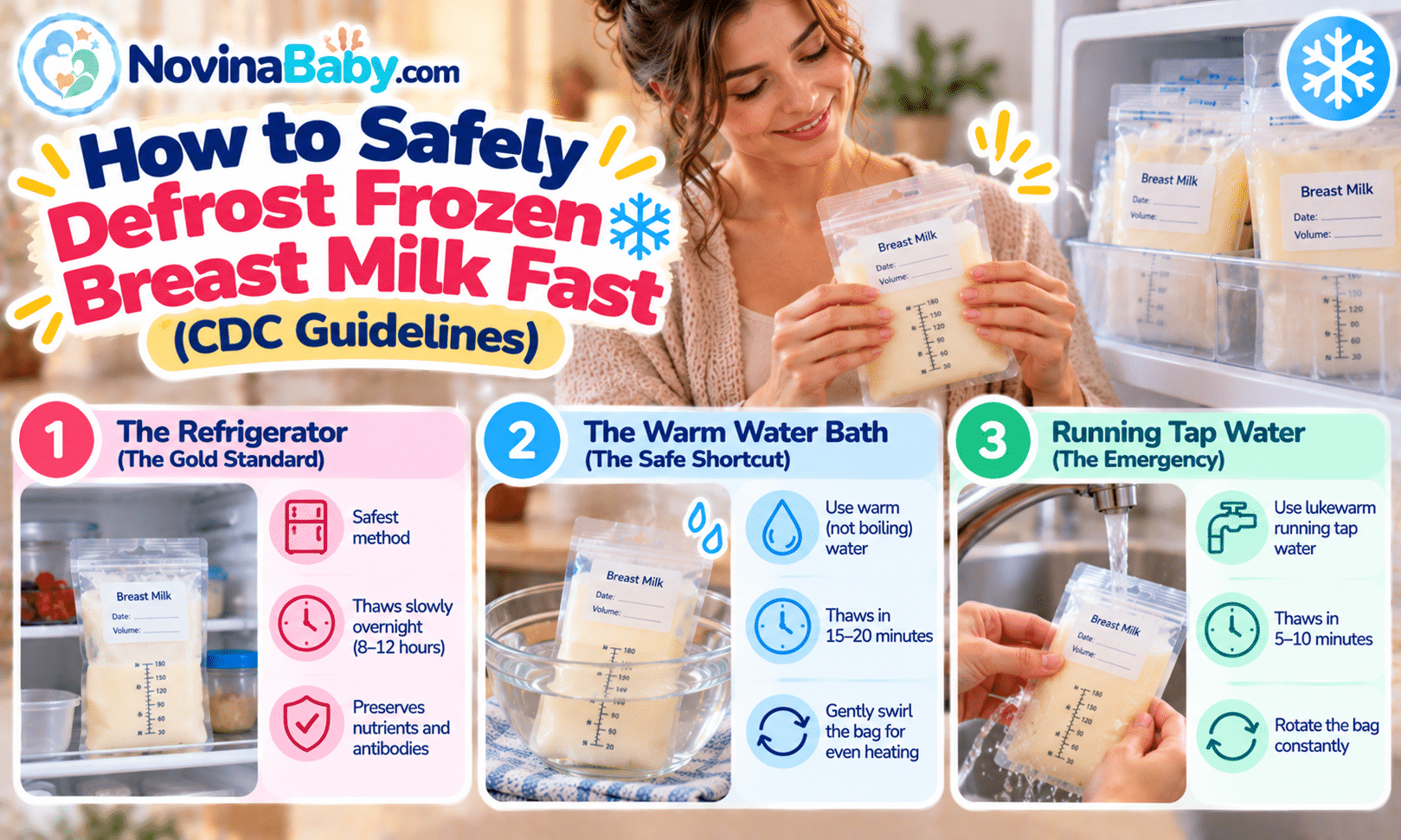
3 Proven Ways to Defrost Breast Milk Safely
To preserve the integrity of your milk and keep bacteria at bay, you must apply gentle, gradual heat. Here are the three CDC-approved methods, ranked from the slowest to the fastest.
Can You Use a Bottle Warmer to Defrost Milk?
Yes, but you must be incredibly careful about the type of warmer you own. As we outlined in our comparison of water bath vs steam bottle warmers, steam warmers use intense, rapid heat. Putting a frozen plastic bag directly into a steam warmer will likely melt the bag and ruin the milk.
If you own a gentle “water bath” style warmer (especially one with a dedicated “Defrost” setting), it is perfectly safe to place your frozen bag inside. The machine will use a low, slow heat cycle to thaw the milk automatically while you tend to your baby.
⏱️ The Confusing “24-Hour Rule” Explained
The CDC states that completely thawed breast milk can be stored in the refrigerator for exactly 24 hours. However, the vast majority of parents misunderstand when this 24-hour clock actually starts.
The clock DOES NOT start when you pull the milk out of the freezer.
The 24-hour clock begins the exact second the last ice crystal melts and the milk becomes 100% liquid. For example, if you place a frozen bag in the fridge at 8:00 AM on Monday, and it takes until 8:00 AM on Tuesday to fully turn to liquid, the milk is safe in the fridge until 8:00 AM on Wednesday. After that 24-hour liquid window closes, you must throw it away.
Why Does My Thawed Milk Smell Like Soap? (High Lipase)
Many mothers successfully defrost a bag of milk, open it up, and immediately panic because the milk smells distinctly like soapy water or metallic coins. Do not throw it away! It is likely not spoiled.
This odor is caused by an excess of an enzyme called lipase. Lipase breaks down the fats in the milk while it sits in the freezer. It is a completely natural process and 100% medically safe for your baby to drink.
However, some babies despise the soapy taste and will refuse the bottle. Unfortunately, once the milk is frozen and thawed, you cannot remove the soapy taste. To prevent this in the future, you must “scald” your freshly pumped breast milk (heating it gently in a pan just until tiny bubbles form around the edges) to deactivate the lipase enzyme before you freeze it.
How to Defrost Frozen Breast Milk (FAQ)
Can I refreeze breast milk that has been completely thawed?
No. The CDC strictly forbids refreezing breast milk once it has completely thawed into a liquid. The process of thawing and refreezing degrades the nutrients and exponentially increases the risk of dangerous bacterial growth.
What if there are still tiny ice crystals in the milk?
If you take a bag of milk out of the fridge and it is mostly liquid but still has slush or tiny ice crystals floating in it, it is technically considered “partially frozen.” According to medical guidelines, it is safe to put partially frozen milk back into the deep freezer.
How long can thawed breast milk sit at room temperature?
Once frozen breast milk is brought to room temperature (or warmed), it can only sit on the counter for a maximum of 2 hours. If your baby begins drinking the bottle, that 2-hour window starts immediately. Any milk left in the bottle after 2 hours must be discarded due to bacteria from the baby’s mouth.
Can I mix freshly pumped warm milk with thawed cold milk?
You should not mix liquids of different temperatures. If you mix fresh, warm milk directly into a cold bag of thawed milk, the warm milk raises the temperature of the entire batch, encouraging bacterial growth. You must chill the fresh milk in the fridge first, and then mix them together once they are both the same cold temperature.
Defrost Your Milk on Autopilot
Standing at the sink for 20 minutes running warm water over a frozen bag is exhausting. Modern technology can do this for you. We have rigorously tested the market to identify the absolute best smart bottle warmers that feature a dedicated, ultra-safe “Defrost” setting specifically designed to gently thaw frozen breast milk bags without melting the plastic or destroying the nutrients.