
🛡️ Nutritional Integrity Verified
📅 Updated for 2026
How to Safely Warm Breast Milk (Without Destroying Nutrients) – You have spent countless hours attached to a breast pump, carefully storing every single drop of your “liquid gold.” When your hungry baby wakes up crying at 2:00 AM, your first instinct is to grab a cold bottle from the fridge and heat it up as fast as humanly possible.
However, rushing this process can ruin all your hard work.
Breast milk is not just food; it is a living biological fluid packed with delicate white blood cells, antibodies, stem cells, and essential digestive enzymes. Exposing it to extreme, rapid, or uneven heat will instantly kill these vital nutrients, leaving your baby with a meal that has lost its immune-boosting superpowers.
Understanding exactly how to safely warm breast milk is a crucial skill for every parent, grandparent, and daycare provider.
In this comprehensive guide, we will break down the biology of breast milk, explore the strict CDC medical guidelines, detail the three safest warming methods, and uncover exactly why the kitchen microwave is your biggest enemy.
The Biology of Breast Milk: What Are We Protecting?
To understand why gentle warming is so critical, you have to understand what makes human milk so uniquely powerful. When you heat breast milk beyond its natural body temperature threshold, you risk denaturing (destroying the structure of) several microscopic elements:
- Immunoglobulins (IgA): These are the primary antibodies that coat your baby’s intestines, acting as a shield against germs and allergies. High heat destroys IgA completely.
- White Blood Cells (Macrophages): Breast milk is packed with living cells that actively hunt and destroy harmful bacteria in your baby’s gut. Boiling water kills these cells instantly.
- Lysozyme and Lactoferrin: These are powerful anti-infective proteins. Lactoferrin also helps your baby absorb iron. Extreme heat breaks down these protein chains.
- Lipase: This is a crucial enzyme that helps your baby digest milk fats. While some moms scald milk to fix a high-lipase (soapy) taste, accidental overheating removes the digestive benefits of this enzyme.
When you learn how to safely warm breast milk, your primary goal is to bring the liquid up to body temperature without ever reaching a temperature that triggers protein denaturation.
🚫 The Absolute Ban on Microwaves
The CDC and pediatricians universally condemn microwaving baby bottles for two scientifically proven, highly dangerous reasons:
- Dangerous Hot Spots: Microwaves do not heat liquids evenly. The outside of the plastic bottle might feel completely lukewarm to your touch, but the milk trapped in the center could literally be boiling. When the baby takes a sip, these hidden hot spots can cause severe, immediate scalding of the mouth, throat, and esophagus.
- Molecular Destruction: The intense, localized radiation heat created by microwaves aggressively breaks down the immunological properties and anti-infective factors in human milk much faster than stovetop heating. It renders the protective antibodies completely useless.
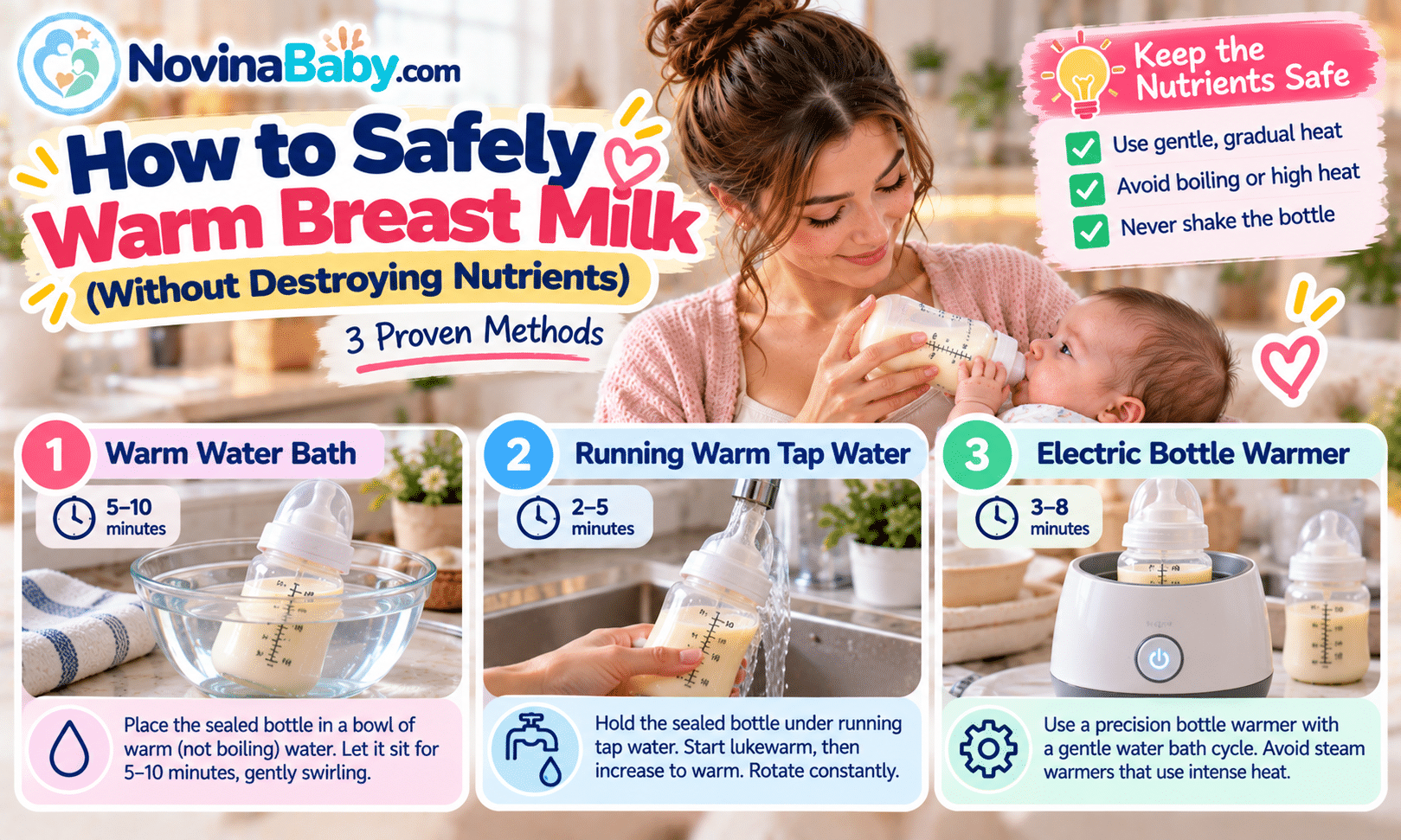
3 Proven Methods to Safely Warm Breast Milk
To preserve the integrity of your milk, you must apply gentle, gradual heat. Here are the three pediatrician-approved methods to bring your chilled milk from the refrigerator to the perfect feeding temperature.
Special Case: How to Thaw Frozen Breast Milk
If you are pulling milk directly from your deep freezer, you cannot simply drop a block of frozen milk into hot water. The extreme temperature shock will cause the storage bag to crack and leak, ruining the milk.
According to the CDC, there are two safe ways to thaw frozen breast milk:
- The Slow Thaw (Recommended): Move the frozen milk bag from the freezer to the refrigerator 12 to 24 hours before you plan to use it. Once it is completely liquid in the fridge, you can warm it using the methods above.
- The Quick Thaw: Place the frozen sealed bag in a bowl of cold water. As the milk thaws, slowly replace the cold water with warmer water until the milk is liquid and reaches room temperature.
🌡️ Testing: What is the Ideal Temperature?
A massive mistake new parents make is thinking the milk needs to be “hot.” The biological goal is simply to bring it to human body temperature, which is roughly 98.6°F (37°C). This mimics the exact temperature of milk coming directly from a mother’s breast.
The Wrist Test: Always test the milk before serving. Gently swirl the bottle, unscrew the cap, and shake a few drops onto the thin, sensitive skin on the inside of your wrist. It should feel completely neutral—neither hot nor cold. If it feels noticeably warm or hot to your skin, it is too hot for your baby’s delicate mouth.
The 2-Hour Rule: Handling Leftover Warmed Milk
You warmed a 5-ounce bottle perfectly, but your baby fell asleep after drinking only 2 ounces. Can you put the remaining 3 ounces back in the fridge and reheat it later?
Absolutely not.
Once a baby drinks from a bottle, the natural bacteria from their saliva flows backward through the nipple and enters the milk. Because the milk is now warm and full of sugars, it becomes a perfect breeding ground for dangerous bacteria.
The CDC is explicitly clear: Once breast milk is brought to room temperature or warmed, and the baby begins feeding, any leftover milk must be discarded within 2 hours. You cannot chill it, and you cannot reheat it. Doing so puts your baby at risk for gastrointestinal infections.
How to Safely Warm Breast Milk (FAQ)
Can I feed my baby cold breast milk straight from the fridge?
Yes, absolutely! There is no medical or biological rule that says babies must drink warm milk. If your baby is happy to accept chilled or room-temperature milk, it is 100% safe, will not cause stomach aches, and will save you a massive amount of time during night feeds.
Why does my thawed breast milk smell like soap?
This is caused by high levels of an enzyme called lipase. Lipase breaks down the fats in the milk while it is stored. It is completely safe for the baby to drink, but some babies reject the soapy taste. If your baby refuses it, you can scald your freshly pumped milk (heating it briefly just until bubbles form at the edges) before freezing it in the future to deactivate the enzyme.
How long can warmed breast milk sit out if the baby hasn’t touched it?
If you warm a bottle but your baby falls asleep before the nipple ever touches their mouth, that pristine, untouched warmed milk can safely sit at room temperature for up to 4 hours. If they still haven’t eaten it by the 4-hour mark, it must be thrown away.
How do I clean my automated electric bottle warmer?
Automated warmers boil water daily, which means they quickly trap hard water minerals (white scale) and can grow mold if left damp. You should descale them every few weeks using a natural white vinegar solution. For full step-by-step instructions, read our comprehensive guide on how to clean and descale a bottle warmer safely.
Stop Wasting Time at 2:00 AM
Now that you know how to safely warm breast milk without destroying its vital nutrients, it is time to make the process completely stress-free. We have rigorously tested the market to find devices that use precise, gentle water baths to protect your liquid gold automatically—so you can get back to sleep faster.