
🦠 Bacteria Prevention
📅 Updated for 2026
5 Dangerous Mistakes Parents Make When Warming Baby Bottles – It is 3:00 AM. Your baby is screaming at the top of their lungs, your eyes are barely open, and you are operating on a severe sleep deficit. In these frantic moments, your only goal is to get a warm bottle of milk into your baby’s mouth as fast as humanly possible.
Unfortunately, this desperate rush for speed is exactly when critical safety errors occur.
Warming a baby bottle might seem like a simple, foolproof task, but infant milk is incredibly delicate. Whether you are feeding liquid gold (breast milk) or powdered formula, the way you apply heat directly impacts your baby’s safety, their digestion, and their overall health.
From destroying vital antibodies to accidentally introducing toxic chemicals into your baby’s diet, small shortcuts can have massive consequences.
To protect your little one (and your own peace of mind), we have compiled the ultimate safety checklist. Here are the five most dangerous mistakes warming baby bottles, the science behind why they are so harmful, and exactly what you should be doing instead.
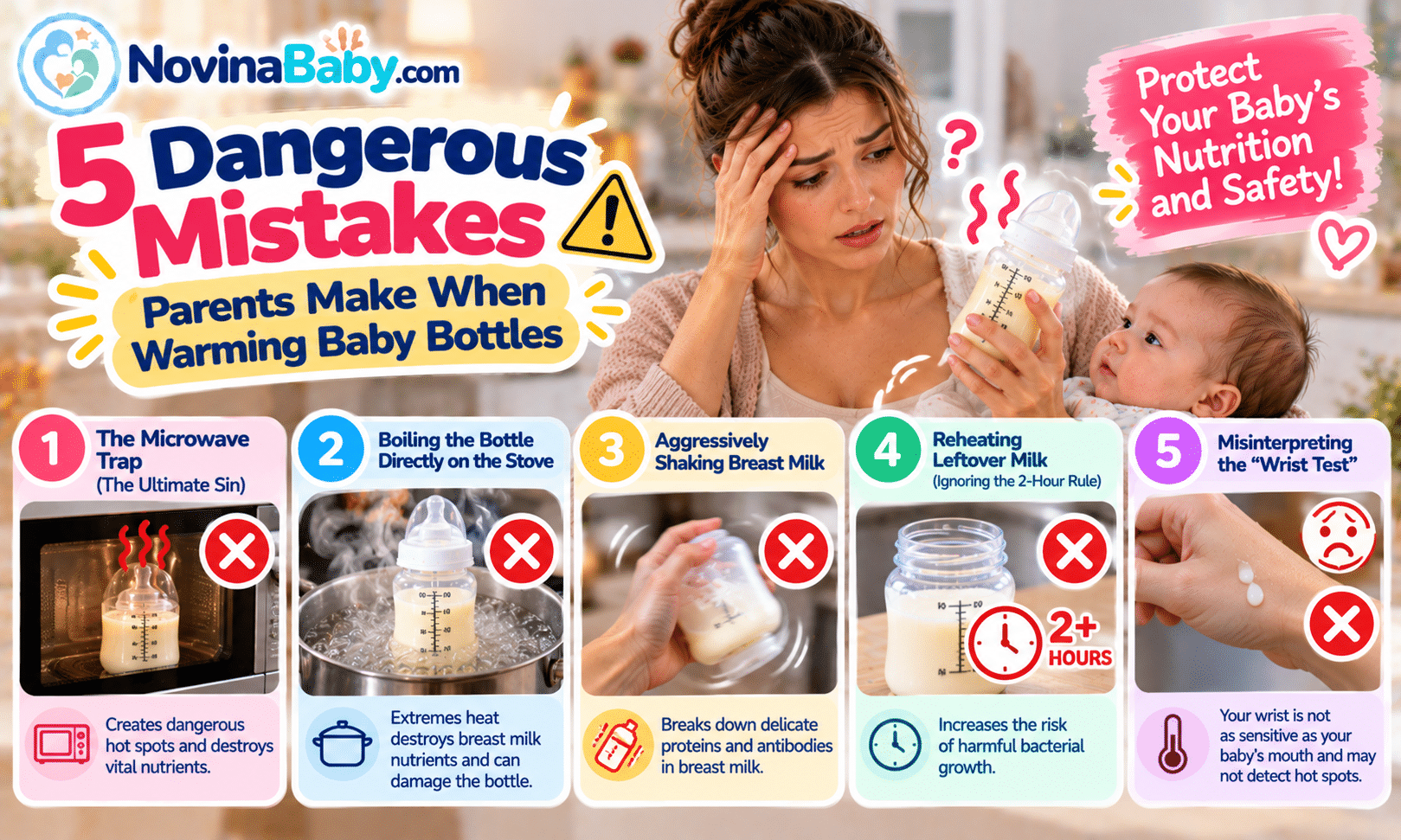
❌ Mistake #1: The Microwave Trap (The Ultimate Sin)
It is the most tempting shortcut in the kitchen, but using a microwave is the single most dangerous mistake you can make when preparing a bottle. The AAP and CDC strictly forbid this practice for two major reasons.
First, microwaves utilize dielectric heating, meaning they heat liquids unevenly from the inside out. This creates hidden “hot spots.” The outside of the plastic bottle might feel perfectly cool to your touch, but the milk trapped in the center could be boiling at 200°F. When your baby takes a sip, these hot spots can cause instant, severe scalding to their mouth and throat.
Second, this intense, aggressive radiation heat permanently denatures the proteins in breast milk. It instantly kills the living white blood cells, digestive enzymes, and antibodies (IgA) that protect your baby from illness.
❌ Mistake #2: Boiling the Bottle Directly on the Stove
Some parents place a prepared baby bottle directly into a pot of actively boiling water on the stovetop to speed up the heating process. This is a massive chemical and nutritional hazard.
While baby bottles are BPA-free, subjecting modern plastics to a rolling boil (212°F) causes the material to degrade rapidly. This degradation can cause the plastic to leach microplastics directly into your baby’s milk. Furthermore, the extreme heat transfer will immediately overheat the milk inside, once again destroying its nutritional value.
❌ Mistake #3: Aggressively Shaking Breast Milk
When you pull a bottle of breast milk out of the fridge, you will notice that it has separated. The thick, creamy hindmilk (fat) floats to the top, while the watery foremilk sits at the bottom. Most parents immediately shake the bottle vigorously, like a cocktail shaker, to mix it back together before putting it in the warmer.
While shaking is necessary for mixing dry powdered formula, shaking breast milk is highly damaging. Human milk is composed of fragile, complex protein chains and living cells. Violent shaking creates “shear stress” that literally breaks these cellular structures apart, rendering the immune-boosting properties useless and degrading the milk’s quality.
❌ Mistake #4: Reheating Leftover Milk (Ignoring the 2-Hour Rule)
You warm a 6-ounce bottle, but your baby falls asleep after only drinking 2 ounces. It feels like a tragedy to pour 4 ounces of liquid gold down the drain, so you put it back in the fridge to reheat later. This is a severe health risk.
The moment your baby’s mouth touches the silicone nipple, bacteria from their saliva flows backward into the bottle. Because the milk is warm and packed with natural sugars, it becomes a biological petri dish. If you chill and then reheat that same milk, the bacteria will multiply exponentially, which can cause severe vomiting and diarrhea.
❌ Mistake #5: Misinterpreting the “Wrist Test”
Every parent knows they should squirt a few drops of milk on the inside of their wrist to test the temperature before giving it to the baby. However, many parents misinterpret what they are actually feeling for.
Because adults are used to drinking hot coffee and hot tea, they assume a baby’s bottle should also feel “hot” or noticeably “warm” on their skin. If the milk feels warm to your adult skin, it is significantly too hot for your baby’s highly sensitive, delicate mouth.
Mistakes Warming Baby Bottles (FAQ)
We know late-night feedings come with a lot of anxiety. Here are the answers to the most common heating questions:
If you are feeding breast milk, a water bath warmer is definitively safer. Steam warmers heat up much faster, but the intense heat is difficult to control and can accidentally degrade the milk’s nutrients. Water baths offer precise, gentle heat transfer. Read our deep dive on water bath vs steam warmers to learn exactly how the mechanics differ.
Yes! There is a common myth that cold milk causes stomach cramps or colic, but this is medically false. If your baby accepts cold milk without fussing, it is 100% safe to feed them straight from the refrigerator, completely eliminating the risk of overheating mistakes.
That white crust is limescale buildup from hard water. If you ignore it, the scale will trap heat, burn out your motor, and harbor bacteria. You must maintain your machine. Check out our step-by-step guide on how to clean and descale a bottle warmer using safe, natural vinegar.
Is it safer to use a steam warmer or a water bath warmer?
Can I give my baby cold milk straight from the fridge?
What if my bottle warmer gets filled with white crust?
Take the Guesswork Out of 3:00 AM Feedings
The easiest way to avoid dangerous heating mistakes is to invest in a machine that does the thinking for you. We have rigorously evaluated the market to identify the absolute best, pediatrician-approved bottle warmers that feature auto-shutoff sensors, gentle water baths, and perfect temperature control to protect your baby’s health.