
🩺 Pediatric Sleep Aligned
📅 Updated for 2026
Best Color Night Light for Baby Sleep – Picture this classic 2:30 AM scenario: Your baby begins stirring in their bassinet for a midnight feeding. Hoping to see what you are doing without turning on the blinding overhead ceiling fixture, you flip on a soft blue star projector, a standard white bedside lamp, or the LED flashlight on your smartphone.
You feed your baby, burp them, and change their diaper. Yet when you lay them back down at 3:00 AM, their eyes are wide open. They are cooing, kicking their legs, and ready to party for the next ninety minutes.
If your baby treats middle-of-the-night wake-ups like morning playtime, the culprit is rarely hunger or gas—it is the wavelength of light in your bedroom.
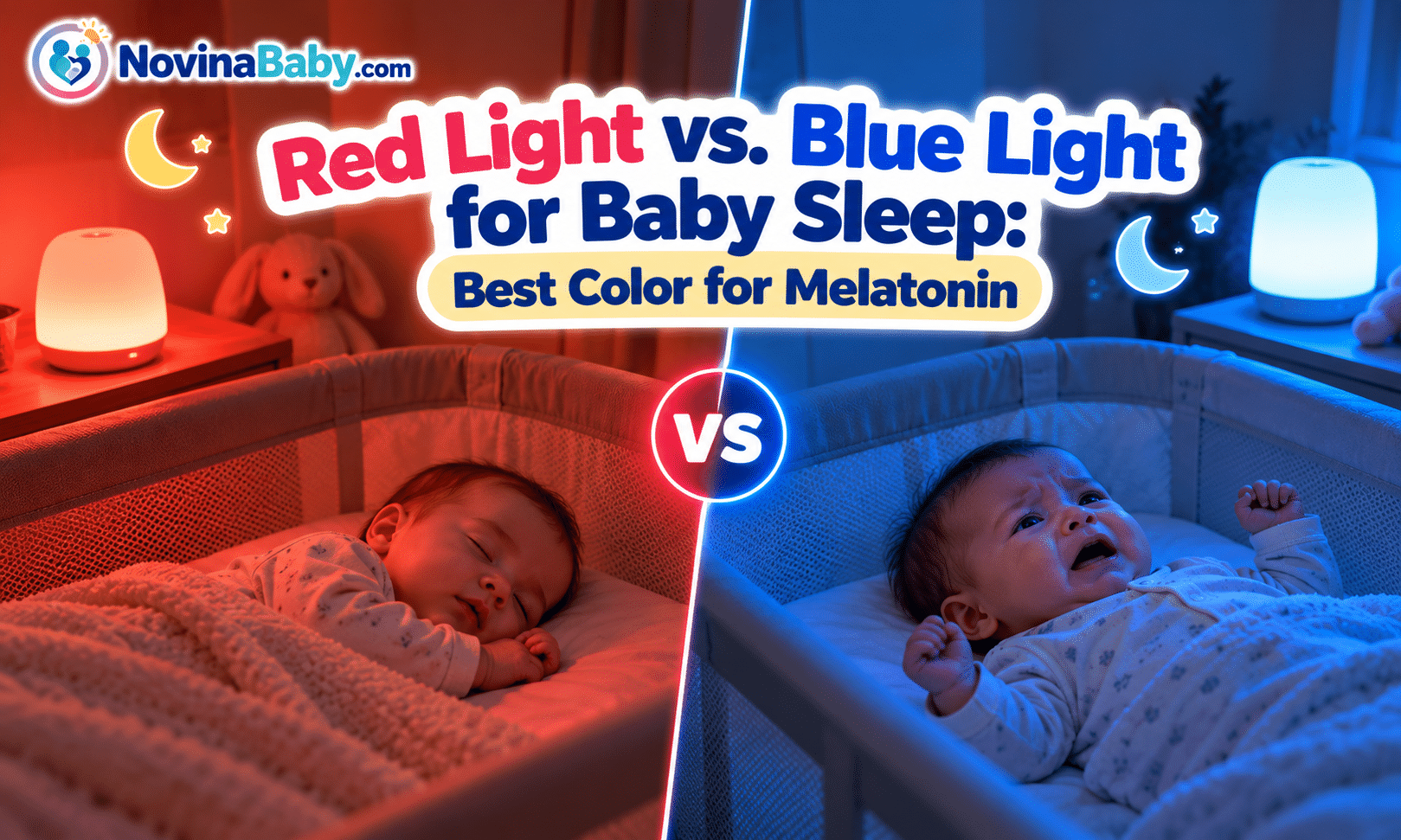
Choosing the best color night light for baby sleep is not an interior design decision; it is applied neurobiology. Different colors of light travel at different wavelengths, sending direct chemical commands from your baby’s retinas to the master clock in their brain. Let’s break down the chronobiology of infant vision, compare red light vs blue light for baby sleep, and show you the exact color settings that protect both your baby’s melatonin and your own precious sleep.
The Biology of Baby Sleep: How Light Controls Melatonin
To understand why a five-minute diaper change under the wrong light can ruin two hours of sleep, we have to look inside the human eye. Beyond the standard rods and cones used for everyday vision, the retina contains a specialized layer of cells called intrinsically photosensitive retinal ganglion cells (ipRGCs).
These cells do not help your baby see shapes; instead, they contain a light-sensitive photopigment called melanopsin. Their sole biological job is to detect environmental light wavelengths and signal the suprachiasmatic nucleus (SCN)—the brain’s master circadian pacemaker—whether it is daytime or nighttime.
- When Melanopsin Detects Short-Wavelength Light (Blue, Green, or Cool White): The brain interprets those wavelengths as midday sunlight. Within seconds, it orders the pineal gland to halt the production of melatonin (the sleep hormone) and triggers a surge of cortisol and histamine to wake the body up.
- When Melanopsin Sees Long-Wavelength Light (Deep Red or Warm Amber): Melanopsin receptors are virtually blind to long red wavelengths (above 600 nanometers). Because these cells are not triggered, the brain believes the room is still pitch black, allowing melatonin to keep flowing uninterrupted.
Furthermore, an infant’s eyes are even more vulnerable to light disruption than an adult’s. During the first year of life, a baby’s crystalline eye lens is completely clear and transparent, allowing up to 70% more short-wavelength blue light to penetrate straight to the back of the retina compared to an adult eye.
Color-by-Color Spectrum Matrix: Best to Worst Night Light Colors
Many modern nursery lamps offer a 16-color RGB rainbow wheel. Before you pick a color based on how cute it looks next to your crib, see how each wavelength impacts your baby’s brain chemistry.
| Light Color | Wavelength / Kelvin | Impact on Melatonin & Brain | Nursery Sleep Verdict |
|---|---|---|---|
| 🔴 Deep Red Light | 620–750 nm (~1000K–1800K) | Zero melanopsin activation; preserves 100% of nocturnal melatonin secretion. | ⭐⭐⭐⭐⭐ #1 Best Choice for 3 AM Feeds & Check-ins |
| 🟠 Warm Amber / Sunset Orange | 590–620 nm (1800K–2200K) | Negligible impact at low brightness; mimics natural sunset cues to trigger drowsiness. | ⭐⭐⭐⭐⭐ Ideal for Bedtime Routine & Toddler Comfort |
| 🟡 Soft Warm White / Yellow | 570–590 nm (2700K–3000K) | Contains hidden blue-spectrum spikes if turned above 20% brightness. | ⭐⭐⭐ Acceptable Only on Lowest Dimmer for Pre-Bed Books |
| 🟢 Green & Purple Light | 495–570 nm (Variable) | Green (530 nm) strongly suppresses melatonin nearly as fast as blue wavelengths. | ❌ Avoid Overnight (Use Green Only for Morning Wake Cues) |
| 🔵 Blue & Cool Daylight White | 450–495 nm (4000K–6500K) | Peak melanopsin trigger (460–480 nm); halts melatonin and spikes alertness cortisol. | ❌ Worst Color for Sleep; Causes 3 AM Split Nights |
Why Red and Amber Light Win the “Red Light vs. Blue Light” Battle
When sleep consultants evaluate red light vs blue light for baby sleep, red and deep amber win on three distinct physiological fronts—not just for your infant, but for you as an exhausted parent.
1. Zero Disruption to Developing Circadian Rhythms (Weeks 6–16)
Newborns are not born with a working circadian clock; for the first few weeks, they experience day-night confusion. Around 6 to 12 weeks of age, their pineal gland begins synthesizing its own nighttime melatonin surge.
Using a pure red or 1800K amber night light during nighttime wake-ups reinforces a crystal-clear biological contrast between bright daytime feeds and dark nighttime feeds, helping your baby consolidate longer 5-to-6-hour stretches of night sleep weeks earlier.
2. Mimics the Natural Light Environment of the Womb
Some parents worry that a red light looks eerie or unnatural in a baby’s room. To a newborn, however, red is the most familiar color in the universe.
During the third trimester of pregnancy, the only external light that filters through a mother’s skin, muscle, and amniotic fluid into the womb is a muted, warm reddish-amber glow (600+ nm). A dim red or amber glow feels biologically safe and womb-like to a fourth-trimester infant.
3. Preserves Parental Night Vision (Rhodopsin Protection)
There is a reason astronomers, submarine crews, and aviation pilots use red flashlights in the dark. Your retina relies on a chemical called rhodopsin for night vision, which instantly bleaches and deactivates the moment you look at a white or blue light—taking up to 30 minutes to regenerate.
Red light does not bleach rhodopsin. Under a dim red light, your pupils stay relaxed, you can clearly see to latch your baby or scoop them from one of the best bedside bassinets, and your own brain stays drowsy so you can fall back asleep within two minutes of returning to bed.
Why Blue Light Is the #1 Enemy of Infant Sleep
Walk down the baby aisle or scroll through online listings, and you will see dozens of nursery night lights, humidifiers, and ocean wave projectors glowing in tranquil shades of ocean blue, aqua, and cool white. Why is blue so popular in marketing if it is terrible for sleep?
Psychologically, adults associate the color blue with calm water and peaceful evening skies. Biologically, however, the human brain perceives 460–480 nm blue light as high-noon solar radiation.
🚨 3 Hidden Sources of Blue Light Sabotaging Your Nursery
- Your Smartphone Flashlight & Screen: Using your phone’s white LED flashlight to check a diaper—or scrolling on a bright phone screen three inches from your baby’s face while nursing—blasts their eyes with intense 460 nm blue light. If you use your phone during night feeds, turn on your phone’s built-in “Red Color Filter” accessibility shortcut.
- Standard “Warm White” LED Bulbs: Unlike old-fashioned incandescent bulbs that burned a warm orange filament, cheap modern LED bulbs create “white” light by coating a high-intensity blue LED diode in yellow phosphor. Even a 3000K white LED emits a strong blue wavelength spike.
- Blue Power LEDs on Nursery Gear: A single tiny blue or green power indicator light on a humidifier, air purifier, baby monitor camera, or one of your nighttime bottle warmers can illuminate an entire dark nursery and catch a baby’s attention between sleep cycles. Cover all blue appliance LEDs with a piece of black electrical tape or light-blocking stickers.
How to Use Night Light Colors by Age & Routine
Knowing that red and amber are the best color night lights for baby sleep is step one; knowing when to turn them on and off is step two. As we explain in our guide on whether newborns actually need a night light, babies under 18 months do not have a cognitive fear of the dark—the light is strictly a functional tool for caregivers.
Best Color Night Light for Baby Sleep (FAQ)
Is red light creepy or scary for babies and toddlers?
Not at all! Adults only associate red light with horror movies or darkrooms because of cultural conditioning. Babies and toddlers have zero negative associations with red light—in fact, newborns find it deeply soothing because it matches the reddish light spectrum they experienced inside the womb. If a pure crimson red feels too intense for your eyes, a deep 1800K amber-orange setting provides nearly identical melatonin protection with a cozy candlelit feel.
What if my portable baby night light only has a “warm white/yellow” mode and no red mode?
Many popular silicone egg tap lights (like the JolyWell or VAVA warm-white models) use a 2700K warm yellow LED alongside an RGB color wheel. If you use warm yellow instead of red or amber, the key is ultra-low intensity (lux). Dim the warm yellow light down to its lowest 1%–5% setting and place it on the floor or behind a chair so only indirect light bounces into the room during a feeding, then turn it completely off once your baby is back in the bassinet.
Can I leave a dim red night light on all night long in the nursery?
Yes! While pitch darkness is optimal once a baby is sleeping through the night (after 4 to 6 months), leaving a pure red or deep amber night light on at its lowest brightness setting (1% to 5%) all night long will not suppress melatonin or interfere with sleep cycles. This is especially helpful for parents room-sharing with a newborn or for toddlers who wake up disoriented in total darkness.
Are moving blue or green star projectors good for helping babies fall asleep?
For most infants, no. Combining short-wavelength blue or green light with rotating ceiling shapes stimulates both the visual cortex and the melanopsin alertness pathway. While a projector can distract a fussy baby during diaper changes, leaving it running at bedtime often delays sleep onset. See our full breakdown of star projector vs soft glow baby night lights for safer ways to use projection lamps.
Upgrade to a True Melatonin-Safe Nursery Night Light
Stop blinding yourself and waking your baby up at 3:00 AM with harsh white lamps or smartphone flashlights. We have tested the top CPSC-safe portable egg lights, red-spectrum nursing lamps, and smart sound-and-light machines to help you protect your baby’s sleep cycles from night one.
Read Our Ultimate Guide on the Best Baby Night Lights of 2026