
⚖️ Hands-On 3 AM Ergonomics
📅 Updated for 2026
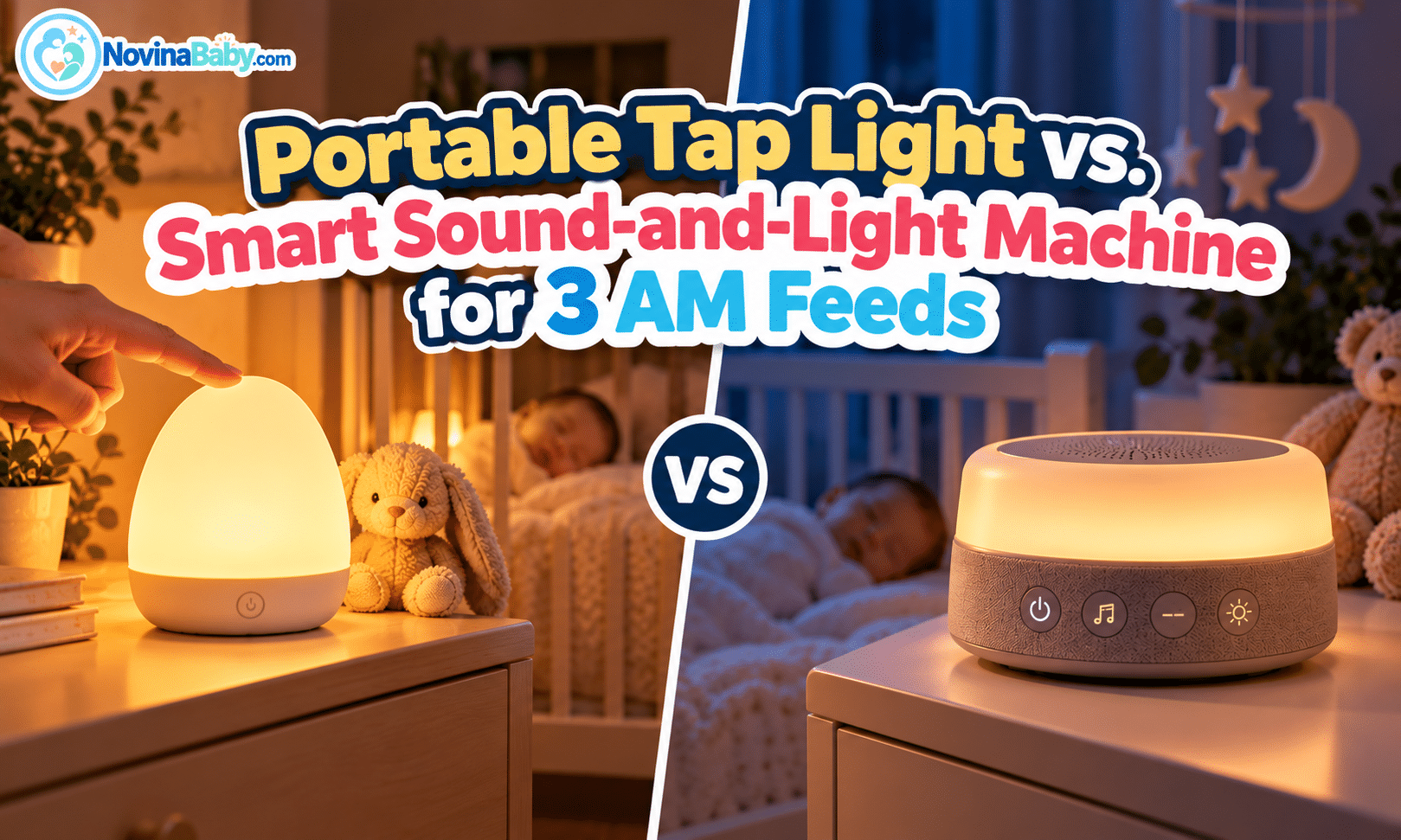
Portable Baby Night Light vs. Smart Night Light – Ask any group of parents in a due-date forum which night light belongs on your baby registry, and you will immediately witness a passionate divide between two very different pieces of hardware.
Half of the parents will tell you to buy a $25 cordless, egg-shaped silicone tap light that sits on your nightstand and travels in your hand from the bed to the changing pad. The other half will insist that a $70+ Wi-Fi smart sound-and-light machine (like the iconic Hatch Rest) is the only nursery device you will ever need from birth through preschool.
When you are comparing a portable baby night light vs smart night light, it is easy to assume the more expensive, app-controlled smart machine automatically replaces a simple tap light. However, once you are actually awake at 3:00 AM trying to latch a squirming newborn or inspect a leaky diaper in a dark bedroom, you quickly discover that stationary ambient lighting and portable task lighting solve two completely different problems.
Let’s break down the real-world ergonomics of both technologies during midnight wake-ups, compare their safety and battery trade-offs, and help you decide which setup belongs in your bedroom.
Quick Comparison Matrix: Portable Tap Light vs. Smart Sound-and-Light Machine
Before diving into how each device performs during a 3:00 AM feeding, here is how cordless portable tap lights stack up against stationary smart sound-and-light hubs across seven core metrics.
| Feature / Metric | Portable Cordless Tap Light (Egg / Silicone Light) | Smart Sound-and-Light Machine (Stationary Hub) |
|---|---|---|
| Primary Function | Localized, mobile “task lighting” that moves with the parent from bed to rocker to changing table. | Stationary room-wide “ambient glow” combined with continuous white noise and programmable schedules. |
| Power Source & Mobility | 100% Cordless rechargeable battery (80–200 hrs on low); lifts off charging base in 1 second. | Must stay plugged into a wall outlet (some Pro models include a short backup battery for power outages). |
| 3:00 AM Control Method | Instant physical tap or press-and-hold stepless dimming on top of the shell. | Smartphone app (Wi-Fi/Bluetooth) or tapping a metal touch-ring across the room. |
| Built-In White Noise | None (Strictly a dedicated silent light source). | Yes (Continuous pink, brown, and white noise, rain, and lullabies). |
| Sleep Training & Toddler Longevity | Great as a handheld hallway bathroom light or toddler bed comfort buddy. | Unmatched (Doubles as a programmable “Okay-to-Wake” clock up to age 6+). |
| CPSC Cord Safety | Zero cord hazard when detached from its USB charging dock. | Requires strict adherence to the 3-foot crib cord clearance rule. |
| Typical Price Range | $18 – $35 | $60 – $100+ (Some brands offer optional app subscriptions) |
1. The Portable Cordless Tap Light: The 3:00 AM Nursing & Diaper Specialist
A portable tap light—often called an “egg light” or “pebble light” (popularized by brands like JolyWell, VAVA, and MediAcous)—is a palm-sized, cordless LED lamp encased in matte, anti-glare ABS plastic or squishy food-grade silicone. It rests on a flat charging coaster or charges via USB-C and operates entirely by touch.
Why It Dominates the First 6 Months of Night Feeds
During the newborn stage, your nighttime routine is highly mobile. You start in your adult bed checking on your baby inside one of the best bedside bassinets, then you sit up or move to a glider chair to nurse, carry the baby to the changing pad for a diaper change, or walk to the kitchen to grab a bottle from one of your nighttime bottle warmers.
A stationary lamp sitting across the room on a dresser creates a frustrating optical problem: your own body casts a dark shadow directly over the baby. When you lean over a changing pad or hunch over to inspect a breastfeeding latch, your torso blocks a stationary room light. To see clearly, you are forced to crank the stationary lamp up to 60% brightness—which lights up the entire room, wakes up your sleeping partner, and stimulates your baby.
With a portable tap light, you keep the brightness at a whisper-dim 5% to 10% and place the egg 6 inches away from the exact spot you need to see—right on the corner of the changing pad or tucked next to your nursing pillow—while the rest of the bedroom stays dark.
The Pros of a Portable Tap Light 👍
| The Cons of a Portable Tap Light 👎
|
2. The Smart Sound-and-Light Machine: The Long-Term Nursery Anchor
A smart sound-and-light machine (led by the Hatch Rest 2nd Gen, Hatch Rest+, Momcozy Smart Baby Sound Machine, and Maxi-Cosi See Pro) combines a multi-color LED diffuser dome with a high-fidelity continuous sound speaker. Connected via Wi-Fi or Bluetooth, it allows parents to program custom color hues, brightness percentages, sound tracks, and time-of-day schedules directly from a smartphone app.
Why It Excels as a Nursery Command Hub
When your baby graduates from your bedroom into their own nursery crib—or even while establishing a structured evening bedtime routine—a smart sound-and-light machine shines because of automation and sensory pairing.
Instead of manually turning on a sound machine and dimming a lamp every night, you can program your smart hub to automatically glow in a soothing 1800K sunset amber with gentle rain sounds at 6:45 PM for bath and pajama time, transition to pitch black (or 2% deep red) with continuous brown noise at 7:15 PM for sleep, and switch to a cheerful green light with birds chirping at 7:00 AM.
📱 The 3:00 AM “Smartphone App Trap”
Here is the biggest hidden flaw of using a smart sound-and-light machine for 3:00 AM newborn feeds: relying on your phone to turn the light on.
Because the smart machine must be plugged in across the room (at least 7 feet away from the baby’s head for hearing safety), you cannot reach its physical touch ring from your bed. If you unlock your bright smartphone screen at 3:00 AM to open the app and adjust the nursery light, your phone blasts your eyes with short-wavelength blue light—instantly suppressing your own melatonin and making it impossible for you to fall back asleep after the feeding. (As we detail in our guide to red light vs blue light for baby sleep, protecting parental melatonin is half the battle!)
Pro Workaround: If you use a smart sound-and-light machine for night feeds, pre-program two physical “Favorite” touch-ring presets before bed: Preset 1 for your normal overnight white noise (0% light), and Preset 2 for “Night Feed Mode” (same white noise + 10% red light). That way, you can simply tap the metal ring on your way to the crib without ever touching your phone.
The Pros of a Smart Sound-and-Light Hub 👍
| The Cons of a Smart Sound-and-Light Hub 👎
|
Why Moving a Sound-and-Light Combo to the Changing Pad Is a Safety Mistake
At this point, you might wonder: “Wait—some premium smart sound-and-light machines (like the Hatch Rest+) come with a rechargeable battery base so you can pick the whole cylinder up. Can’t I just carry my smart sound machine to the changing table at 3:00 AM like a tap light?”
No, and pediatric audiologists strongly advise against doing this.
In 2014 and updated 2023 acoustic policy statements, the American Academy of Pediatrics warned that infant sound machines placed too close to a baby’s head can exceed safe occupational noise limits and damage delicate cochlear hair cells. To protect your baby’s hearing, a white noise speaker must stay at least 7 feet (2 meters) away from your baby’s ears and operate below 50 decibels.
If your night light and your white noise speaker are fused into the exact same cylinder, carrying that light so it sits 8 inches from your baby’s head on the changing pad means you are also placing a 65-decibel speaker 8 inches from their eardrums. Keeping your continuous sound machine stationary across the room while carrying a silent, cordless tap light in your hand solves this acoustic hazard completely.
Head-to-Head Scenarios: Which Light Wins for Your Routine?
When deciding on a portable baby night light vs smart night light, look at how you plan to feed and where your baby will sleep over the next twelve months.
🤱 Scenario 1: Room-Sharing & Breastfeeding in Bed (Months 0–6)
Winner: Portable Cordless Tap Light. As we noted in our guide on whether newborns need a night light, the first four months are all about quick, surgical visibility in your master bedroom. A cordless silicone or matte egg light sitting on your nightstand lets you tap it on with your knuckle, check your breastfeeding latch, carry it to the changing station to follow our 3 AM diaper change protocol, and tap it off without ever waking your partner.
🍼 Scenario 2: Midnight Bottle Prep & Multi-Room Navigation
Winner: Portable Tap Light (With Carrying Handle or Clip). If you pump or formula-feed and need to walk down a dark hallway to the kitchen fridge at 2:00 AM, a cordless tap light acts as a melatonin-safe lantern. You can carry it in one hand while holding the bottle in the other, completely avoiding harsh hallway ceiling switches. (Compare this with automated hallway options in our breakdown of plug-in motion sensor vs rechargeable touch night lights).
🛏️ Scenario 3: Independent Crib Sleep & Bedtime Routines (Months 4–18)
Winner: Smart Sound-and-Light Machine. Once your baby transitions to their nursery crib and drops down to one or zero night feeds, a stationary smart sound-and-light hub takes over. It anchors their circadian bedtime cue every evening at 7:00 PM and fills the nursery with continuous, sleep-linking pink or brown noise all night long while keeping cords safely away from the crib—helping you avoid the top nursery night light safety mistakes.
🏆 Scenario 4: The Veteran Parent “Hybrid Setup” (Under $90 Total)
The Ultimate Solution: Use Both Together! Ask seasoned second-time parents and they will tell you this isn’t an “either/or” choice. Put a stationary smart sound-and-light machine on the dresser 7 feet away from the crib to handle continuous white noise and future toddler schedules, and keep an inexpensive $20 cordless tap light on your nightstand or glider table for hands-on 3:00 AM nursing and diaper changes.
Portable Baby Night Light vs. Smart Night Light (FAQ)
Do smart sound-and-light machines require a monthly subscription to work?
No, the core night light, white noise tracks, schedules, and “Okay-to-Wake” clock functions work 100% free without a subscription. While brands like Hatch offer an optional membership (Hatch+) that unlocks extra bedtime stories, guided meditations, and music playlists, you never need to pay a monthly fee to use the custom color wheel, continuous pink/white noise, or time-to-rise routines.
What happens to a smart sound-and-light machine if the Wi-Fi goes out at night?
Modern smart nursery hubs store your programmed schedules locally on the device’s internal memory chip. If your home Wi-Fi drops in the middle of the night, the machine will continue playing its white noise and maintaining its night light setting without interruption—and you can still control it manually using the physical touch ring on top of the unit.
Are squishy silicone animal tap lights safe to put inside a baby’s crib or bassinet?
Not for infants under 12 months old. Even if a squishy silicone tap light is BPA-free, cordless, and cool to the touch, the AAP mandates a 100% bare crib or bassinet for the first year of life. Keep portable tap lights on the nightstand, dresser, or changing table outside the sleep space until your child transitions to a toddler bed.
How long does the battery last on a portable egg tap light between charges?
When used on the lowest dim setting (1% to 10% brightness) strictly for 3:00 AM feedings and diaper changes, a quality rechargeable egg light typically lasts 100 to 200 hours on a single charge—which translates to roughly 2 to 3 weeks of nighttime use. If you rest it back on its charging coaster every morning, it will stay at 100% indefinitely.
See Which Portable Tap Lights & Smart Hubs Ranked #1 in 2026
Whether you want a $22 stepless-dimming egg light for your bedside caddy, a programmable Wi-Fi sound-and-light hub, or both, we tested the top models for minimum lumen dimness, red-light purity, and 3:00 AM ease of use. Explore our full side-by-side comparison and build your ultimate nighttime feeding setup.
Read Our Ultimate Guide on the Best Baby Night Lights of 2026