
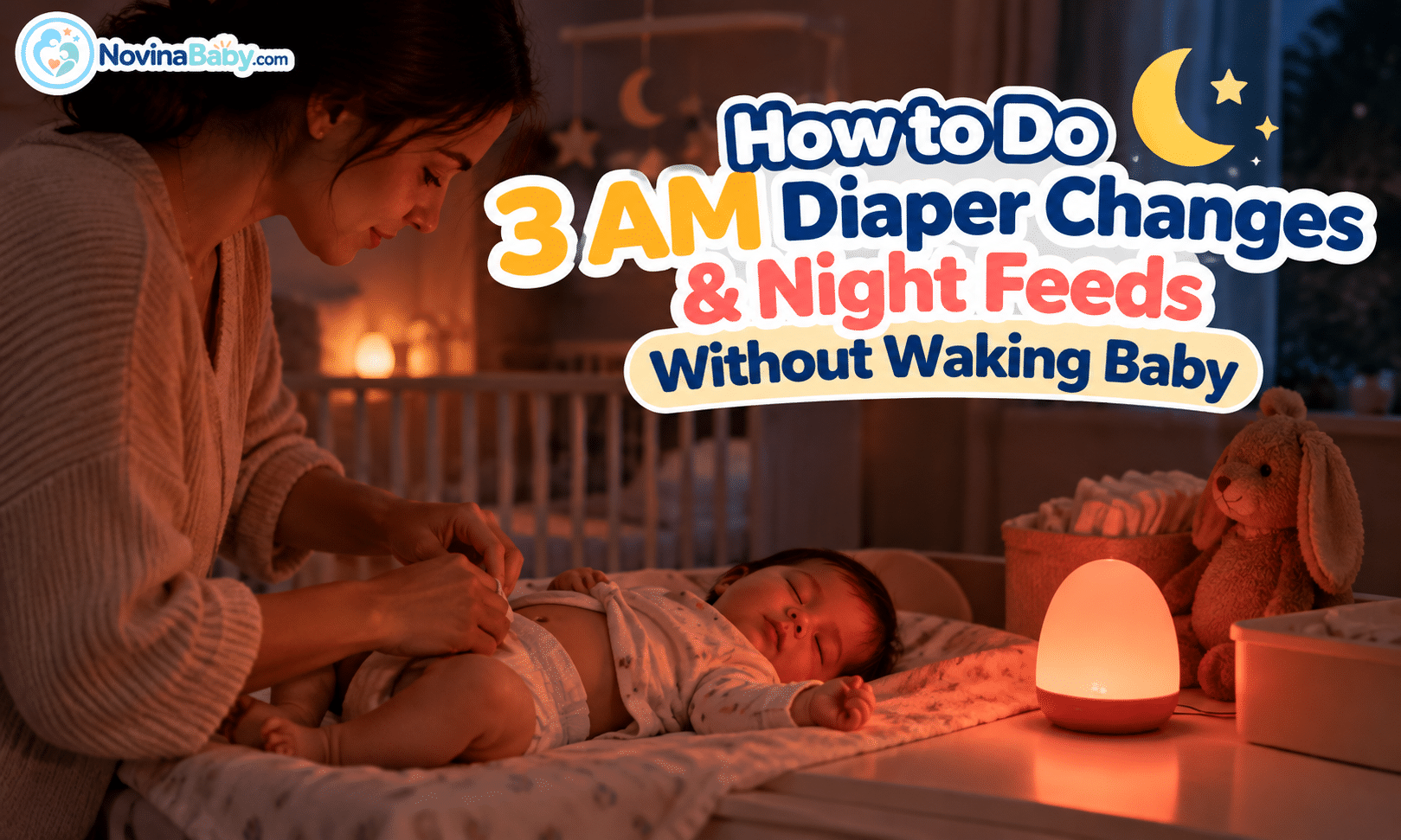
🌙 Low-Stimulation Choreography
📅 Updated for 2026
How to Change Diaper at Night Without Waking Baby – Every new parent has lived through this soul-crushing 3:00 AM betrayal: Your baby wakes up stirring for a midnight feeding. You nurse them or give them a warm bottle, and by the final ounce, they are milk-drunk, heavy-limbed, and completely asleep in your arms.
Then, you smell it—or you feel a suspiciously heavy, soggy diaper.
Doing the responsible thing, you carry your sleeping baby over to the changing table, unsnap their pajamas, and touch a cold wet wipe to their skin. Instantly, their eyes fly wide open. They arch their back, let out an outraged shriek, and just like that, your peaceful 20-minute feeding turns into a 90-minute middle-of-the-night battle to get them back to sleep.
Learning how to change a diaper at night without waking your baby is an art form that combines timing, sensory manipulation, and circadian-safe lighting. Let’s break down when you can legally skip the midnight diaper change altogether, the exact “Feed-Change-Feed” sequence that keeps babies drowsy, and six sensory hacks to make 3:00 AM wake-ups nearly invisible.
First Rule of 3 AM Club: Do You *Actually* Need to Change That Diaper?
Before you unswaddle a sleeping infant at 2:30 AM, ask yourself whether the diaper change is medically necessary. In the first four weeks of life, newborns have an active gastrocolic reflex—meaning their bowels automatically contract and poop almost every time milk hits their stomach.
However, around 6 to 8 weeks of age, most babies stop pooping overnight completely. Once your baby only produces urine at night, changing a mildly wet diaper at 3:00 AM does far more harm to their sleep architecture than leaving them undisturbed until morning.
| Diaper Scenario at 3 AM | The Verdict | Pediatric & Sleep Science Reason |
|---|---|---|
| Any Poop (Stool) Present | 🚨 CHANGE IMMEDIATELY | Digestive enzymes and acidity in infant stool burn delicate skin within 30 minutes and risk urinary tract infections. |
| Wet (Pee Only) — Newborn Under 6 Weeks | ⚠️ CHANGE (Before or Mid-Feed) | Newborns hold tiny bladder volumes and wake every 2–3 hours; changing during the wake window prevents leaks and tracks hydration. |
| Wet (Pee Only) — Baby Over 6–8 Weeks Old | 💤 LET THEM SLEEP (Do Not Change) | Modern disposable diapers use super-absorbent polymer (SAP) cores that wick urine away from the skin for up to 10–12 hours. |
| Active Diaper Rash or Leaking Pajamas | 🚨 CHANGE IMMEDIATELY | Damp cotton pajamas chill a baby’s core temperature, and inflamed skin requires fresh zinc oxide barrier cream. |
🛡️ The Bedtime “Barrier Armor” Trick
If you plan to skip pee-only diaper changes overnight once your baby hits 8 weeks old, prep their skin during the final 7:00 PM bedtime routine: pat their skin bone-dry, apply a thick “frosting” layer of 40% zinc oxide diaper paste or pure petroleum ointment to create a waterproof seal over their skin, and size up one diaper size (or switch to dedicated 12-hour overnight diapers) to prevent 4:00 AM waistband blowouts.
Timing Is Everything: Should You Change Before or After the Night Feed?
The #1 tactical error parents make when learning how to change a diaper at night without waking a baby is saving the diaper change for the very end of the feeding.
Warm breast milk and formula contain natural cholecystokinin (CCK) and L-tryptophan—hormones and amino acids that act as a biological sedative. If you wait until your baby finishes eating to strip their clothes off and wipe them down, you undo all that natural drowsiness. Worse yet, lifting a baby’s legs toward their chest on a full stomach of milk compresses their lower esophageal sphincter, causing immediate spit-up all over your clean changing pad.
Use These 2 Proven Chronology Sequences Instead:
- Sequence A: Change First, Then Feed to Sleep (Best for Bottle Feeders & Calm Wakers): As soon as you lift your baby from one of the best bedside bassinets, change their diaper immediately while your bottle is heating up in one of your fast nighttime bottle warmers. Even if the diaper change annoys them slightly, the warm bottle immediately afterward will soothe them straight back into deep sleep. (For more speed strategies on the bottle side, check out our midnight feeding survival guide).
- Sequence B: The “Feed-Change-Feed” Sandwich (Best for Breastfed Newborns & Poop-During-Feed Babies): If your newborn screams furiously upon waking—or always poops 5 minutes into nursing—nurse them on the first breast (or offer two-thirds of the bottle) to take the frantic edge off their hunger. Then, burp them, perform a fast low-light diaper change, and offer the second breast (or the remaining 1 ounce of the bottle) as a “top-off dessert” to lull them back to sleep.
6 Sensory Hacks to Change a Diaper Without Triggering the Brain’s “Wake Switch”
An infant’s nervous system wakes up fully when exposed to three sudden sensory shocks: short-wavelength light, cold temperature drops, and vestibular tilting. Eliminate all three with these six nighttime modifications.
🔴 1. Use a Low-Lux Red or Amber Portable Night Light (Placed Below Eye Level)
Never turn on a bathroom light, closet light, or white bedside lamp during a diaper change. As we proved in our scientific guide to red light vs blue light for baby sleep, even 60 seconds of white or blue light hits your baby’s retinal melanopsin receptors and halts melatonin production.
The Pro Setup: Keep a cordless, rechargeable red or 1800K amber tap light right next to your changing pad. Position it slightly behind the wipe container or below the level of your baby’s head (review our spatial blueprint on where to place a night light in the nursery) so the light illuminates the diaper zone without shining directly into your baby’s upward-facing eyes.
🧥 2. Only Use “Two-Way Zipper” Pajamas & Bottom-Zip Sleep Sacks
Button-snap sleepers are a parent’s worst enemy at 3:00 AM. Trying to line up 14 tiny metal snaps in dim red light takes forever, and unzipping a standard top-down sleeper exposes your baby’s warm chest and stomach to chilly 68°F bedroom air—instantly startling them awake.
The Pro Setup: Dress your baby exclusively in inverted/two-way zipper footie pajamas (which unzip from the ankle upward) or magnetic sleepers, paired with a swaddle or sleep sack that opens from the bottom hem. Your baby’s chest, arms, and torso stay 100% snug and warm while you only expose their legs for 30 seconds.
🧻 3. Ban the “Cold Wipe Shock” (And Skip Wipes for Pee-Only Changes)
Touching a wet wipe that has been sitting in a 68°F room to a sleeping baby’s 98.6°F skin feels like jumping into an ice bath. Furthermore, pediatric dermatologists note that you do not need to use a wet wipe for a urine-only diaper change at night, as modern diapers absorb moisture so effectively that excess wiping only strips the skin barrier and chills the baby.
The Pro Setup: If there is poop and you must wipe, pull 2 wipes out of the pack before you unfasten the diaper and hold them tightly inside your closed warm fist (or tuck them under your own thigh/armpit while nursing) for 60 seconds. They will warm up to exact human body temperature without needing an electric wipe warmer.
🧷 4. Execute the “Diaper-Under-Diaper” Formula1 Pit Stop
The longer your baby’s skin is exposed to cool air, the more likely they are to wake up fully—or worse, pee all over their clean outfit mid-change, forcing a full wardrobe change that guarantees a wide-awake baby.
The Pro Setup: Before unfastening the dirty diaper, unfold the clean diaper completely, fluff the leg gussets, and slide it underneath your baby’s bottom right behind the dirty one. Unfasten the dirty diaper, use the clean front inner flap of the old diaper to wipe downward, pull the dirty diaper out, and immediately fold the fresh diaper up. Total air-exposure time: under 10 seconds.
🔄 5. Use the “Pelvic Roll” Instead of the High Ankle Lift
Most parents change a diaper by grabbing both of the baby’s ankles and lifting their legs straight up into the air. That sudden vertical tilt triggers a newborn’s vestibular Moro (startle) reflex and forces stomach acid up into their throat.
The Pro Setup: Keep your baby’s back and hips flat on the changing pad. Instead of lifting their ankles into the air, gently roll your baby’s hips 45 degrees to the left to wipe and tuck the diaper underneath, then roll them 45 degrees to the right. They stay horizontal, calm, and reflux-free.
🤫 6. Maintain the “Silent, Boring Nighttime Persona”
Your baby is wired to fall in love with your voice and your smiling eyes. If you make direct eye contact, smile broadly, or talk in a cheerful, high-pitched voice at 3:00 AM (“Oh, did someone make a big stinky poop?!”), your baby’s brain floods with social dopamine. During night feeds and changes, keep your face relaxed, avert direct eye contact, let your continuous white noise machine do the shushing, and save all playful chatter for 7:00 AM.
Pre-Staging Your Nighttime Station Before You Go to Bed
As we explained in our breakdown of whether newborns need a night light, fumbling through dresser drawers in the dark creates noise and stress that wakes your baby up. Every evening at 9:00 PM before you get into bed, spend 60 seconds resetting your bedside caddy:
- Pre-Unfold 3 Diapers: Take 3 diapers out of the tight plastic sleeve, open them flat, and flare out the leg cuffs so they are ready to grab silently with one hand.
- Warm the Changing Surface: Wipeable foam changing pads (like the Keekaroo Peanut or Skip Hop pad) are wonderfully hygienic, but cold polyurethane rubber shocks a sleeping baby awake. Lay a soft flannel receiving blanket or cotton liner across the center of the wipeable pad for nighttime changes so the surface feels warm to the touch.
- Pre-Dim Your Night Light: Whether you use a portable silicone egg light or a smart lamp (compare both options in our guide to a portable tap light vs smart sound-and-light machine), turn it on before bed to verify it is locked onto its lowest red or amber memory setting so it doesn’t accidentally flash at 100% white brightness when you tap it at 3:00 AM.
How to Change Diaper at Night Without Waking Baby (FAQ)
Are electric baby wipe warmers worth buying for 3 AM diaper changes?
Most veteran parents and pediatricians consider electric wipe warmers unnecessary. They dry out the bottom wipes, can breed bacteria if not cleaned frequently, and the wipe cools down rapidly the second you pull it into the air anyway. Warming a wipe inside your closed fist for 30 seconds before opening the diaper is free, safer, and just as effective.
Should I change my baby’s diaper during a 10:30 PM “Dream Feed”?
No, unless they have pooped. The entire goal of a dream feed is to fill your baby’s stomach while they remain 95% asleep. Changing a wet diaper during a dream feed will almost always wake the baby up completely and defeat the purpose of the dream feed. Instead, put a fresh, high-absorbency diaper and barrier cream on them at their 7:30 PM bedtime and leave it untouched during the 10:30 PM dream feed.
Can I change my baby’s diaper right inside the bassinet or on our adult bed at night?
Yes! In fact, changing your baby on a foldable waterproof mat right on the foot of your bed (or inside a sturdy Pack ‘n Play changer) saves you from carrying them across the room. However, avoid changing a diaper directly on the bassinet mattress pad itself, as a sudden mid-change pee fountain or blowout will soak the bassinet sheet and force you to strip the bed at 3:00 AM.
What if my newborn poops 10 minutes AFTER I already put them back in the bassinet?
It is deeply frustrating, but if you hear or smell a bowel movement after laying them down, you must change it. However, wait 3 to 5 minutes after you hear the first grunt before picking them up—newborns often poop in two or three separate waves over several minutes, and waiting briefly prevents you from changing them twice in a row. Keep the red light at 5% brightness, change them silently using the side-roll technique, and offer a pacifier or 2 minutes at the breast to resettle them.
Master the 3:00 AM Change With the Right Bedside Light
The secret to changing a diaper in 45 seconds without waking your baby is a one-tap, red-spectrum night light you can carry right to the changing pad. Explore our hands-on review of the best cordless silicone egg lights, clip-on changing table lights, and smart nursery lamps of 2026.
Read Our Ultimate Guide on the Best Baby Night Lights of 2026