
👁️ Infant Vision Verified
📅 Updated for 2026
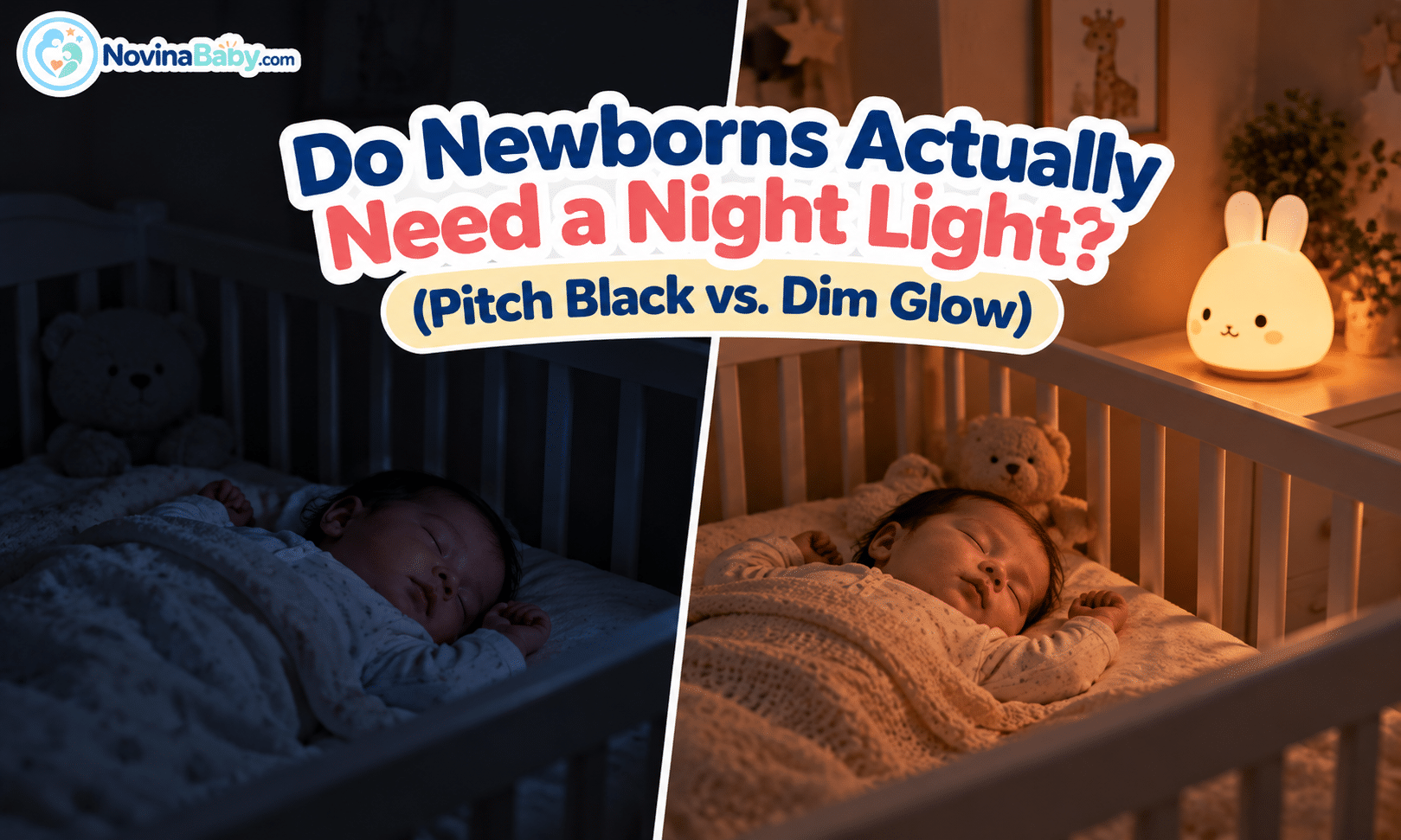
Do Newborns Need a Night Light? – As you put the finishing touches on your nursery or master bedroom sleep corner, a deceptively simple question inevitably pops up: Do newborns need a night light, or should they sleep in complete pitch blackness?
Ask ten veteran parents and you will hear two opposite camps. Sleep trainers will tell you to tape black garbage bags over your windows so you cannot even see your hand in front of your face. Meanwhile, postpartum nurses and lactation consultants will tell you that a bedside night light is the #1 non-negotiable item you need on night one home from the hospital.
Here is the clinical truth that reconciles both camps: Your newborn does not need a night light to sleep—YOU need a night light to care for your newborn safely.
Understanding when to keep your bedroom pitch black and when to switch on a dim, melatonin-safe glow is the secret to curing newborn day-night confusion while surviving 3:00 AM feedings intact. Let’s look at the developmental biology of newborn vision, why pitch darkness wins for independent sleep, and how to use a night light strategically during the fourth trimester.
The Developmental Truth: Are Newborns Afraid of the Dark?
When adults lie awake in a pitch-black room, our imaginations can easily conjure up anxiety or disorientation. Naturally, empathetic new parents project that feeling onto their tiny infant, worrying that waking up in a dark bassinet will make their baby feel scared or abandoned.
Biologically and neurologically, it is impossible for a newborn to be afraid of the dark. Here is why:
- They Just Spent 9 Months in Near-Total Darkness: Inside the uterus, your baby floated in a dark, cozy environment where over 99% of external light was blocked by abdominal tissue. Darkness does not feel scary to a newborn; it feels like home.
- Newborn Visual Acuity Is Only 8 to 12 Inches: At birth, a baby’s eyesight is roughly 20/400. They can only focus on high-contrast shapes directly in front of their face (the exact distance from the breast to a mother’s eyes). They cannot see across the bedroom to notice whether shadows are present or not.
- Fear Requires Object Permanence and Imagination: True nyctophobia (fear of the dark) requires a child to imagine unseen threats lurking in the shadows. Cognitive neuroscientists confirm that children do not develop this level of abstract imagination until at least 18 to 24 months of age—a milestone we cover in detail in our guide on when babies develop a fear of the dark.
Why *Parents* Desperately Need a Night Light During the Newborn Stage
If your baby is completely content in the dark, why is a nursery night light still considered a registry essential? Because a newborn wakes up every 2 to 3 hours around the clock for feeding, burping, diaper changes, and soothing.
Trying to care for a fragile 7-pound infant in total darkness is dangerous, and flipping on a bright overhead ceiling light or hallway fixture destroys everyone’s sleep. Here are the four reasons a dim bedside night light is essential for parents:
🤱 1. Achieving a Pain-Free Breastfeeding Latch & Safe Bottle Pacing
In the first six weeks postpartum, breastfeeding mothers and newborns are both learning the mechanics of a deep latch. Trying to aim a rooting newborn onto the breast in pitch darkness frequently leads to a shallow nipple latch, causing painful cracked skin and excess air swallowing.
Similarly, if you are bottle-feeding pumped milk or formula using one of the best nighttime bottle warmers, you need enough soft illumination to read the ounce markings on the bottle, ensure the silicone nipple is stays filled with milk rather than air, and watch your baby’s pacing cues.
🧷 2. Inspecting 3:00 AM Diaper Blowouts & Umbilical Cord Stumps
Newborns poop constantly—often during or immediately after every nighttime feeding due to the gastrocolic reflex. Wiping a baby clean in pitch darkness means you will almost certainly miss hidden stool in skin folds, leading to painful diaper rash, or accidentally snag their healing umbilical cord stump with the diaper tab.
A portable, dimmable tap light positioned right on the changing pad gives you localized visibility to clean thoroughly without lighting up the whole room.
🛡️ 3. Visual Safe-Sleep & Spit-Up Checks in the Bassinet
Newborns are notoriously noisy sleepers. Because of their immature respiratory systems and active REM sleep cycles, they grunt, squeak, whistle, and pause their breathing for a few seconds at a time (periodic breathing).
When you hear a strange gurgle at 2:00 AM, a low-glow night light lets you glance through the breathable mesh walls of your bedside bassinet to confirm your baby’s chest is rising, check for silent spit-up, and verify that their Velcro swaddle hasn’t loosened near their chin.
🦶 4. Preventing Postpartum Tripping Hazards & Medication Errors
Walking across a pitch-black bedroom while carrying a newborn—especially when recovering from a C-section or extreme sleep deprivation—is a major fall hazard over splayed bassinet legs, pets, or rocking chair runners. Furthermore, if you need to measure infant gas drops (simethicone) or vitamin D drops in a syringe at night, proper dim lighting prevents dangerous dosing mistakes.
Quick Matrix: Pitch Black vs. Dim Glow Across Baby Stages
How you manage bedroom lighting changes dramatically as your baby’s brain and circadian rhythm mature over the first two years. Use this reference table to match your lighting strategy to your baby’s exact age.
| Baby’s Age Stage | Daytime Nap Lighting | Overnight Sleep Lighting | Night Feeding / Care Lighting |
|---|---|---|---|
| Weeks 0 to 6 (Newborn Day-Night Confusion) | Bright natural daylight & normal household noise to build circadian contrast. | Pitch black (or 1%–5% deep red floor glow if parents need visual checks). | Dim red or warm amber night light (under 15% brightness) during feeds only. |
| Weeks 7 to 16 (Melatonin Surge Phase) | Dimmed room with blackout curtains as baby becomes alert to visual distractions. | 100% Pitch Black while baby is sleeping. | Tap-on red/amber light for quick feeds; turn completely OFF once baby is back down. |
| Months 4 to 18 (Sleep Consolidation & Crib) | 100% Pitch Black (Blackout shades mandatory for connecting 45-minute nap cycles). | 100% Pitch Black all night long. | Keep lights OFF unless an emergency diaper blowout occurs. |
| Months 18 to 24+ (Toddler Imagination Phase) | Dark room (or soft 5% amber glow if toddler resists dark room). | Continuous 1%–5% red or amber comfort glow if fear of the dark emerges. | Programmed “Okay-to-Wake” color cues (Red = stay in bed; Green = morning). |
How to Cure Newborn “Day-Night Confusion” With Strategic Lighting
One of the most exhausting parts of the first month home is day-night confusion. Your newborn sleeps like a Peaceful rock for four hours straight at 2:00 PM on the living room couch, then wakes up every 45 minutes between midnight and 5:00 AM wanting to eat and stare around the room.
Why does this happen? Inside the womb, your baby was rocked to sleep all day long by your walking motion, and woke up to party at night whenever you lay down still in bed. Furthermore, newborns are born with almost zero natural melatonin production; they rely on residual maternal melatonin passed through the placenta or breast milk until their own pineal gland matures around 8 to 12 weeks.
☀️🌙 The 2-Part Circadian Reset Protocol
The fastest way to flip your newborn’s internal clock is to create a dramatic environmental contrast between 7:00 AM and 7:00 PM:
- Expose Them to Morning & Afternoon Daylight: During the first 6 weeks, do not put your newborn to nap in a pitch-black cave at 10:00 AM. Open the blinds during daytime feeds, take morning stroller walks in indirect sunlight, and let them nap in ambient daylight so their optic nerve registers daytime photon levels.
- Enforce the “7 PM Blackout & Red-Light Rule”: Starting at 7:00 PM, treat your bedroom like a nocturnal sanctuary. Keep the room dark, quiet, and boring. When your baby wakes for a feeding at 11:00 PM, 2:00 AM, or 4:00 AM, use only a dim red or amber night light, avoid lively eye contact or high-pitched talking, and switch the light back off (or down to 1%) the second they return to the bassinet.
Why must that nighttime feeding light be red or amber rather than white or blue? As we proved in our scientific breakdown of red light vs blue light for baby sleep, short-wavelength blue and white light trick your baby’s retinal receptors into thinking the sun just rose—actively delaying their circadian clock development.
Why Pitch Black Wins After 8 to 12 Weeks (The “Micro-Arousal” Trap)
While leaving a very dim red night light on all night long during the first few weeks does not harm melatonin, something important changes around 8 to 12 weeks of age: your baby’s eyesight sharpens, and they become intensely curious about the physical world.
Babies do not sleep in one solid 8-hour block. Instead, they transition between light and deep sleep cycles every 45 to 50 minutes. At the end of every 45-minute cycle, a baby experiences a brief “micro-arousal” where they stir, shift their head, and flutter their eyelids open for three seconds.
- In a 100% Pitch-Black Room: When your 3-month-old opens their eyes during a 3:00 AM micro-arousal and sees nothing at all, their visual cortex stays bored and unstimulated. They close their eyes and link directly into the next 45-minute sleep cycle.
- In a Lit Room: If a bright night light illuminates the crib bars, wall art, mobile, or your silhouette in bed, your baby’s brain locks onto those intriguing shapes. That three-second micro-arousal instantly turns into a full wake-up where they start babbling or crying for attention.
Therefore, once your baby passes the 8-week mark, the optimal strategy is pitch darkness while sleeping, paired with an instant-tap night light that you turn on only when you are actively feeding or changing them. We detail this exact choreography in our guide on how to do 3 AM diaper changes and night feeds without waking your baby.
3 Rules for Using a Night Light Safely With a Newborn
If you are adding a night light to your bedside table for those first four months of room-sharing, make sure you set it up using these three pediatric guidelines:
- Choose a Cordless Tap Light or App-Controlled Smart Lamp: Fumbling for a tiny rotary switch on a lamp cord at 3:00 AM while your baby cries is frustrating. Choose either a soft silicone tap light you can carry from your bed to the changing table, or a smart sound-and-light machine you can trigger with one finger. Compare both technologies in our breakdown of a portable tap light vs smart sound-and-light machine.
- Hide the Bulb Below the Mattress Line: Never place a night light on a high shelf or dresser edge where your baby can stare directly at the glowing LED diode through their bassinet mesh. Place the light below the level of the bassinet mattress or behind an object so you only get soft, indirect “bounce light.” Read our complete setup blueprint on where to place a night light in baby room.
- Enforce the 3-Foot Cord Zone: If your night light plugs into a wall outlet, ensure both the unit and the electrical cord are positioned at least 3 feet away from your baby’s bassinet or crib to eliminate any strangulation or heat hazards.
Do Newborns Need a Night Light (FAQ)
Does sleeping with a night light on damage a newborn’s eyes or cause nearsightedness?
No, that myth has been thoroughly debunked by pediatric ophthalmologists. The rumor originated from a single flawed 1999 study that failed to account for genetics. Follow-up clinical studies published in Nature and the Journal of Investigative Ophthalmology & Visual Science discovered that nearsighted (myopic) parents were simply more likely to leave a night light on so they could see in their baby’s room at night—and those parents passed their nearsighted genes to their children. A dim night light does not damage infant eye development.
Does ababy monitor need a night light to see the baby in the dark?
No! Modern video baby monitors use invisible infrared (IR) LEDs to produce crystal-clear black-and-white night vision in 100% pitch-black rooms. In fact, placing a bright night light too close to a baby monitor camera can actually trick the camera’s light sensor out of night-vision mode, resulting in a grainy, dark image. Keep your night light away from the camera lens.
When should I stop letting my newborn nap in bright daylight?
Once your baby resolves their initial day-night confusion—typically between 6 and 8 weeks of age—you will notice them becoming much more alert and easily distracted by light during the day. That is your cue to start closing the blackout curtains and turning on white noise for daytime naps in the bassinet or crib so they don’t get overtired from “catnapping.”
Can I use a Himalayan salt lamp as a newborn night light?
While Himalayan salt lamps emit a lovely warm amber color, pediatric safety experts generally advise against them for baby nurseries for three reasons: they are heavy and shatter hazardously if pulled off a dresser, they use hot incandescent bulbs, and genuine salt blocks sweat and “leach” salty moisture in humid rooms (especially if you run a nursery humidifier), creating an electrical and corrosion hazard.
Make 3:00 AM Feeds Effortless Without Waking Your Baby
While your newborn loves sleeping in the dark, having a stepless-dimming red or warm-amber night light at your bedside saves your sanity during every midnight feeding and diaper change. Explore our hands-on rankings of the top cordless silicone nursing lights, smart nursery lamps, and motion-sensor lights built for tired parents.
Read Our Ultimate Guide on the Best Baby Night Lights of 2026