

💡 Evidence-Based Feeding Facts
📅 Updated for 2026
How to Prevent Gas and Colic When Bottle Feeding – There is nothing more heartbreaking for a new parent than watching their newborn scream in agony after a meal.
They clench their tiny fists, pull their knees tightly to their chest, and let out a high-pitched wail that can last for hours. This terrifying phenomenon is often caused by trapped gas bubbles in their immature digestive system.
When a baby drinks from a bottle, they inevitably swallow small pockets of air alongside the milk, which eventually become painfully trapped in their intestines.
Learning exactly how to prevent gas and colic when bottle feeding is absolutely crucial to restoring peace in your home and helping your baby sleep.
While you cannot completely redesign a newborn’s digestive tract, you can drastically change your feeding technique to eliminate swallowed air.
Let’s dive into the five proven, pediatrician-backed strategies to stop the crying and make mealtime comfortable again.
5 Proven Strategies to Eliminate Trapped Air
The secret to solving this problem lies in the preparation of the milk and the angle at which you feed.
Follow these five critical steps to successfully prevent gas and colic when bottle feeding:
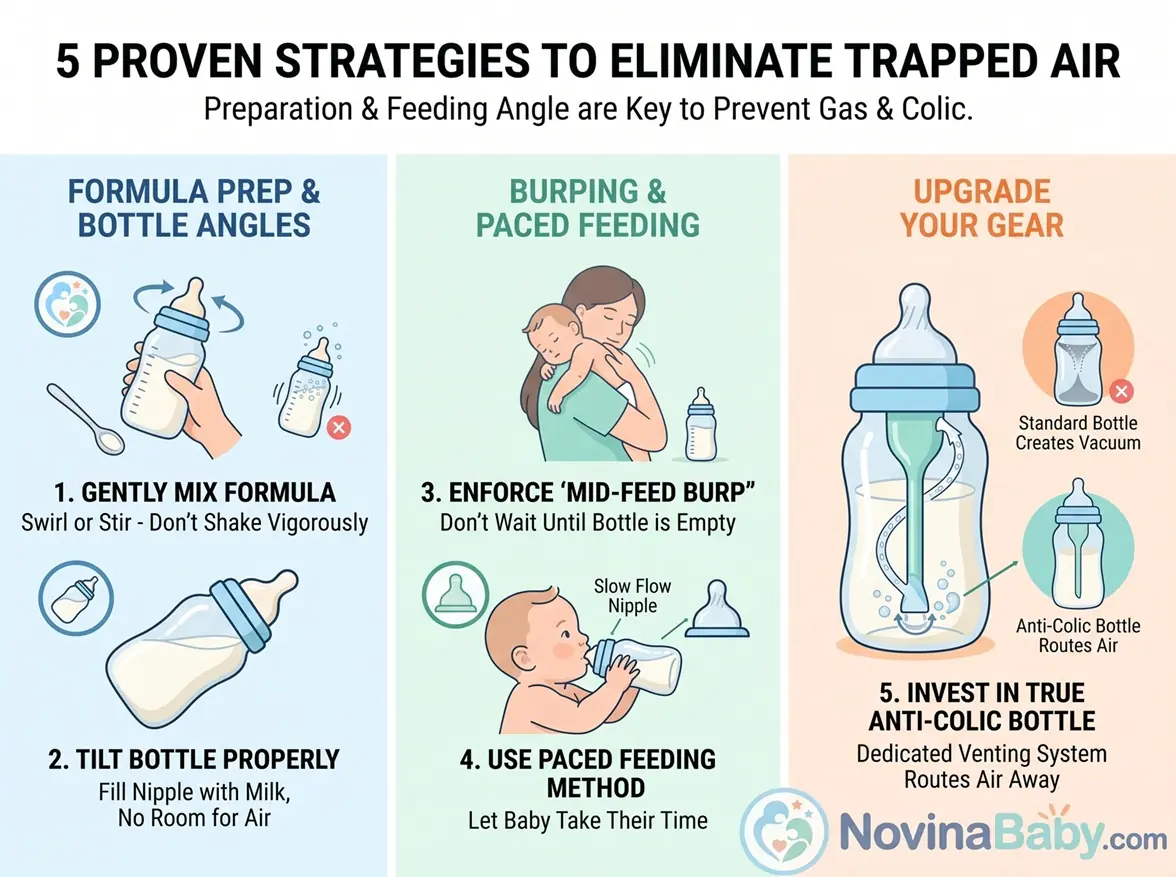
What to Do When the Gas is Already Trapped
Even if you execute a flawless feeding technique, some babies with highly sensitive stomachs will still develop gas.
When the crying starts and you can feel that their tummy is tight and bloated, you need an immediate intervention.
First, lay your baby flat on their back on a soft blanket.
Gently grab their ankles and perform the “Bicycle Legs” exercise, slowly pushing one knee at a time up towards their stomach to physically force the gas bubbles out of their intestines.
If physical exercises fail, consult your pediatrician about over-the-counter Simethicone gas drops, which work by breaking down large gas bubbles into smaller, easily passable ones.
Frequently Asked Questions (FAQ)
How long does baby colic usually last?
Colic typically peaks around 6 weeks of age and begins to resolve itself significantly by the time the baby is 3 to 4 months old, as their digestive system matures and strengthens.
Can the type of formula cause extreme gas?
Yes. Some babies have difficulty breaking down the heavy milk proteins in standard cow’s milk formula. If gas persists despite changing bottles, ask your doctor about switching to a gentle, partially hydrolyzed, or lactose-free formula.
Is it normal for a newborn to strain and grunt while pooping?
Yes, this is very normal and is often called “Infant Dyschezia.” Newborns have not yet learned how to coordinate their abdominal muscles with their pelvic floor, so they grunt and turn red while trying to push out gas or stool.
Ready to Stop the Crying?
Now that you know exactly how to prevent gas and colic when bottle feeding, your very first step should be upgrading to a medically trusted vessel. We’ve rigorously evaluated the market for the absolute best internal venting systems that actively route air away from your baby’s tummy.