
🛡️ CPSC ASTM F2906 Compliant
📅 Updated for 2026
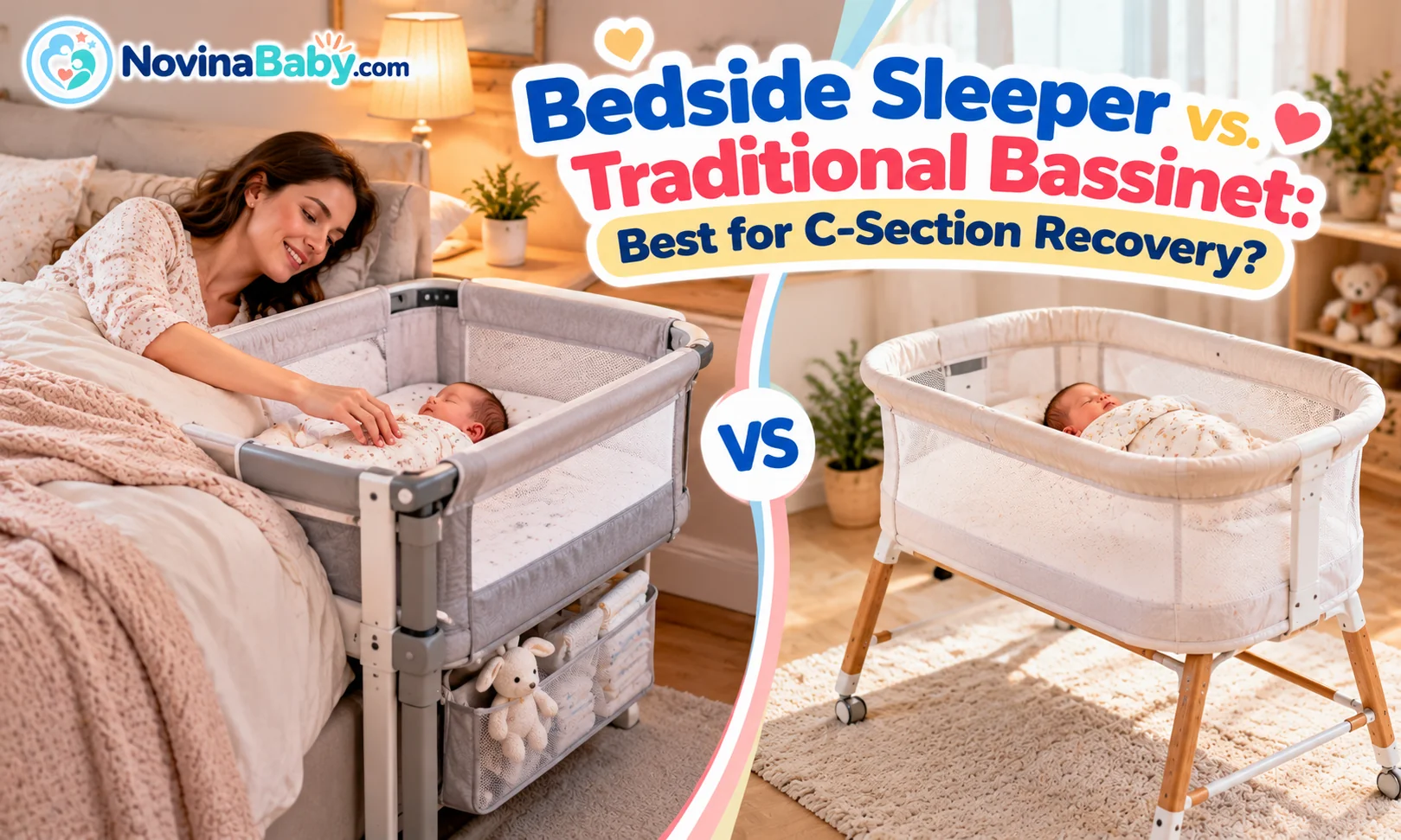
Bedside Sleeper vs. Traditional Bassinet – Whether you have a scheduled Cesarean delivery on the calendar or want to be fully prepared in case an unplanned C-section happens during labor, setting up your master bedroom requires strategic ergonomic planning.
A C-section is major abdominal surgery. Yet, unlike almost any other surgical patient, you are sent home 48 to 72 hours later with a 7-to-9-pound newborn who needs to be lifted, fed, burped, and soothed every two to three hours around the clock.
When you are shopping for your baby’s first bed, the terms “bassinet” and “bedside sleeper” are often thrown around interchangeably. However, in the comparison of a bedside sleeper vs traditional bassinet, the mechanical differences in side-wall height, base clearance, and mattress attachment determine whether you can pick up your baby from a seated position in bed—or whether you are forced to painfully swing your legs out of bed ten times a night.
Let’s examine the biomechanics of postpartum healing, compare the federal CPSC safety standards for both categories, and help you choose the exact frame geometry that matches your adult bed and recovery needs.
The Biomechanics of C-Section Recovery at 3:00 AM
To understand why your choice of newborn bed matters so much after surgery, consider what happens to your core muscles every time your baby cries at night.
During a Cesarean birth, your obstetrician makes an incision through skin, subcutaneous tissue, the tough connective fascia covering your abdominal wall, and separates your rectus abdominis muscles. For the first three to four weeks postpartum, two specific movements trigger sharp, pulling pain along the incision line:
- Torso Twisting under Load: Rotating your upper body to the side while holding an 8-pound baby with outstretched arms places intense shear stress on your healing abdominal fascia.
- The “Sit-to-Stand” Lever: Contracting your core to push yourself up from a soft adult mattress, swinging your legs over the edge, and bending forward over a high rail engages the exact muscle group right behind your stitches.
even for mothers recovering from a vaginal delivery with perineal stitches or pelvic floor soreness, minimizing unnecessary middle-of-the-night getting up and down preserves critical physical energy.
Quick Comparison Matrix: Bedside Sleeper vs. Traditional Bassinet
While both products fulfill the AAP safe sleep guidelines for room-sharing during the first six months, they are regulated under two separate federal safety standards and built with very different frames.
| Feature / Metric | Bedside Sleeper (Co-Sleeper / Swivel) | Traditional Standalone Bassinet |
|---|---|---|
| Side-Wall Mechanism | Features a zip-down drop wall or spring-loaded lowering wall for horizontal reach-in access. | Four fixed, stationary perimeter walls (10–14 inches high); requires lifting baby up and over the top rail. |
| Connection to Adult Bed | Straps directly to the adult bed frame (drop-side) or swivels directly over the mattress (cantilever base). | Freestanding unit; sits near the bed with a few inches of clearance around all four sides. |
| C-Section Ergonomics | ⭐⭐⭐⭐⭐ Superior (Zero standing required; minimal abdominal strain). | ⭐⭐⭐ Moderate (Usually requires sitting on bed edge or standing up to lift baby safely). |
| Federal Safety Standard | 16 CFR Part 1222 / ASTM F2906 (or ASTM F2194 for enclosed swivel models). | 16 CFR Part 1218 / ASTM F2194 (Bassinets and Cradles). |
| Room-to-Room Mobility | Low (Heavy steel base or strapped tightly to the adult bed frame). | High (Lightweight folding frames or detachable pods easily move to the living room). |
| Popular Examples | Halo BassiNest Swivel Sleeper, Chicco Next2Me Dream, Mika Micky Bedside Sleeper. | Snoo Smart Sleeper, BabyBjörn Cradle, Fisher-Price Soothing View. |
1. What is a Bedside Sleeper? (The C-Section Recovery Champion)
A bedside sleeper is engineered specifically to eliminate the physical barrier between your adult mattress and your baby’s sleep space—without ever placing the baby inside the dangerous environment of an adult bed. In the bedside sleeper vs bassinet debate, bedside sleepers are divided into two mechanical sub-types:
🔄 Type A: The 360-Degree Swivel Sleeper (e.g., Halo BassiNest Swivel Sleeper)
The Halo BassiNest Swivel Sleeper is widely considered by obstetricians and lactation consultants to be the single best bedside bassinet for C-section recovery. Instead of strapping to your bed, it uses a heavy-duty, 4-pronged base that tucks under your bed frame (requiring just 1.5 inches of under-bed floor clearance).
The basket hovers directly over your mattress and rotates 360 degrees. When you need to get out of bed, you simply push the basket gently to the side so you can swing your legs out unimpeded. When feeding, you press down on the spring-loaded front wall with your forearms, scoop your baby horizontally toward your chest, and the wall automatically pops back up and locks for safety.
⚓ Type B: The Drop-Side Attached Co-Sleeper (e.g., Chicco Next2Me Dream & Mika Micky)
Models like the Chicco Next2Me Dream and the Mika Micky Bedside Sleeper sit right alongside the edge of your bed and feature one mesh wall that unzips or slides down via a one-handed lever. Using long nylon anchor straps that wrap around your adult bed frame or slats, the sleeper locks completely flush against your mattress.
With 6 to 11 height adjustment levels and retractable feet that fold inward if you have a solid platform bed, these co-sleepers allow you to soothe your baby with a hand on their chest or slide them over for nursing without lifting your torso off the pillow.
The Pros of a Bedside Sleeper 👍
|
The Cons of a Bedside Sleeper 👎
|
2. What is a Traditional Standalone Bassinet?
A traditional bassinet is a fully enclosed, four-walled freestanding infant bed supported by stationary legs, folding travel legs, or a rocking base. Unlike a bedside sleeper, all four perimeter walls remain permanently fixed at full height (typically 10 to 14 inches above the mattress pad), and the unit is never strapped to the adult bed.
Why Parents Still Choose Standalone Bassinets
If bedside sleepers are so convenient for reach-in access, why do millions of parents still choose a standalone bassinet? The answer comes down to portability, bedroom layout flexibility, and smart soothing technology.
First, many modern luxury bedrooms feature solid-base upholstered beds, thick padded side rails, or floor-to-ceiling storage drawers that cannot accommodate under-bed swivel bases or anchor straps. A standalone bassinet can be placed anywhere—2 feet away from the bed, at the foot of the bed, or next to a rocking chair.
Second, standalone frames include ultralight travel models that fold flat in seconds to carry downstairs for daytime naps, as well as elite automated smart sleepers like the Snoo Smart Sleeper, which requires four enclosed rigid walls to safely house its robotic motion motors and built-in swaddle clips (a topic we explore further in our guide on whether smart bassinets are worth the money).
The Pros of a Standalone Bassinet 👍
|
The Cons of a Standalone Bassinet 👎
|
CPSC Safety Showdown: ASTM F2906 vs. ASTM F2194
When comparing a bedside sleeper vs bassinet, parents frequently ask a smart safety question: “Wait—weren’t drop-side cribs banned by the government? Why are drop-side bedside sleepers legal?”
Drop-side full-size cribs were banned in 2011 because heavy toddler weight and cheap plastic tracks caused the movable wooden rail to detach slightly from the crib mattress, creating a V-shaped gap underneath where infants could slip through and suffocate. Bedside sleepers are engineered and regulated under a completely different federal rule: 16 CFR Part 1222 (ASTM F2906).
🛡️ The 2 Mandatory CPSC Safety Features of a Certified Bedside Sleeper
To legally pass ASTM F2906 in the United States, a drop-wall bedside sleeper must incorporate two non-negotiable mechanical safeguards:
- The 4-Inch Permanent Barrier Wall: Even when the drop side is unzipped and lowered all the way down, a certified bedside sleeper never drops completely flat to form a bridge onto the adult bed. It always retains a rigid, breathable mesh lip at least 4 inches high above the bassinet pad. This lip prevents your newborn from rolling out of the bassinet onto your soft adult mattress—and prevents your heavy adult comforter or pillow from drifting into the baby’s sleep zone.
- The Anti-Gap Anchor Strap System: A drop-side sleeper is only legally safe to use with the wall lowered when it is physically strapped to the adult bed using the manufacturer’s heavy-duty attachment straps. If you push a drop-side sleeper next to your bed with the side wall down without fastening the anchor straps, kicking the legs at night will push the unit 2 inches away from your mattress, creating a deadly wedging gap.
Leaving the drop-wall down without securing the anchor straps is one of the most dangerous bassinet safety mistakes new parents make. If you ever use a bedside sleeper in “standalone mode” away from your bed, the fourth mesh wall must be zipped and locked all the way up.
4 Bed Frame Measurements to Take Before You Buy
Roughly 30% of bassinet returns happen because parents buy a bedside sleeper without measuring their adult bed first. Grab a tape measure and check these four dimensions in your bedroom today:
📏 1. Under-Bed Floor Clearance
Does your bed sit flush on the carpet, or do you have under-bed storage drawers? Swivel sleepers like the Halo BassiNest require 1.5 inches of open gap under the bed rail for the metal feet to slide beneath. Drop-side sleepers like the Chicco Next2Me Dream solve this with spring-loaded articulated feet that fold inward when pressed against a solid platform base.
📐 2. Floor-to-Top-of-Mattress Height
Measure from your bedroom floor to the very top of your adult mattress. Standard beds sit at 22 to 25 inches, while thick pillow-top mattresses on box springs can tower at 30 to 33 inches. Always verify the maximum height adjustment of the sleeper so the lowered lip aligns properly with the top of your mattress.
🛏️ 3. Side-Rail Overhang (Upholstered & Sleigh Beds)
If your bed has a wide wooden or upholstered side lip that juts out 3 to 5 inches wider than your mattress, a standard flat-sided co-sleeper cannot sit flush against the mattress edge. For wide-lip bed frames, a cantilever swivel bassinet (which reaches over the lip from above) or a traditional standalone bassinet is much safer.
🚶♀️ 4. Side Walkway Width (Tripping Hazard Check)
Measure the distance between the side of your bed and the bedroom wall or dresser. Some wide-stance bassinets have splayed stability legs that stick out 28 to 32 inches. When you are healing from a C-section, tripping over a protruding metal leg in the dark is dangerous. If your walkway is under 24 inches, look for tuck-under legs. (And if your bedroom has zero bedside clearance at all, see our comparison of bassinet vs crib vs Pack ‘n Play for foot-of-the-bed solutions).
Remember that regardless of whether you choose a swivel bedside sleeper, a strapped co-sleeper, or a traditional bassinet, both styles have the same developmental lifespan. Once your baby hits 15–20 pounds or begins rolling onto their side around 3 to 5 months, you must immediately follow our steps on when and how to transition your baby from bassinet to crib.
Bedside Sleeper vs. Traditional Bassinet (FAQ)
Which is better for a C-section: a swivel bassinet or a drop-side co-sleeper?
Most C-section mothers prefer a 360-degree swivel bassinet (like the Halo BassiNest) over a fixed drop-side co-sleeper for one big reason: getting out of bed. A fixed drop-side co-sleeper blocks the top half of your bedside, forcing you to scoot down toward the foot of the bed to stand up. A swivel bassinet pushes right out of the way so you can swing your legs straight out of bed from your normal sleeping spot without twisting your incision.
Can I leave the side wall of a bedside sleeper down all night long?
Yes, only if the bedside sleeper is certified to ASTM F2906, is adjusted to the exact height specified in the manual, and is tightly anchored to your adult bed frame with the included safety straps so there is zero gap between the sleeper and your mattress. If it is not strapped to the bed, the side wall must remain locked in the fully upright position at all times.
What if I have an adjustable motorized bed (like a Sleep Number or Tempur-Pedic)?
Never strap a drop-side co-sleeper to a motorized adjustable bed frame. If you raise the head of your adult mattress using the remote, it creates a large, triangular entrapment gap against a stationary co-sleeper. Instead, use a standalone bassinet or a cantilever swivel bassinet (kept in its locked, four-walled upright mode whenever the adult mattress is inclined).
Do bedside sleepers hold more weight than traditional bassinets?
generally, they have similar limits: most traditional bassinets and bedside sleepers max out at 15 to 20 pounds (though select heavy-duty co-sleepers like the Mika Micky are weight-rated higher, up to 30–33 lbs). However, remember that regardless of the weight limit, you must stop using any bassinet or bedside sleeper the moment your baby begins rolling over or pushing up on hands and knees.
Protect Your Postpartum Recovery & Your Baby’s Sleep
Whether you need a 360-degree swivel sleeper that glides over your pillow after a C-section, a tall drop-side co-sleeper, or an ultra-lightweight traditional bassinet, we have tested the safest options on the market. Explore our full side-by-side comparison of bed heights, under-bed clearance requirements, and CPSC safety ratings.