
⚖️ ASTM & CPSC Standards Verified
📅 Updated for 2026
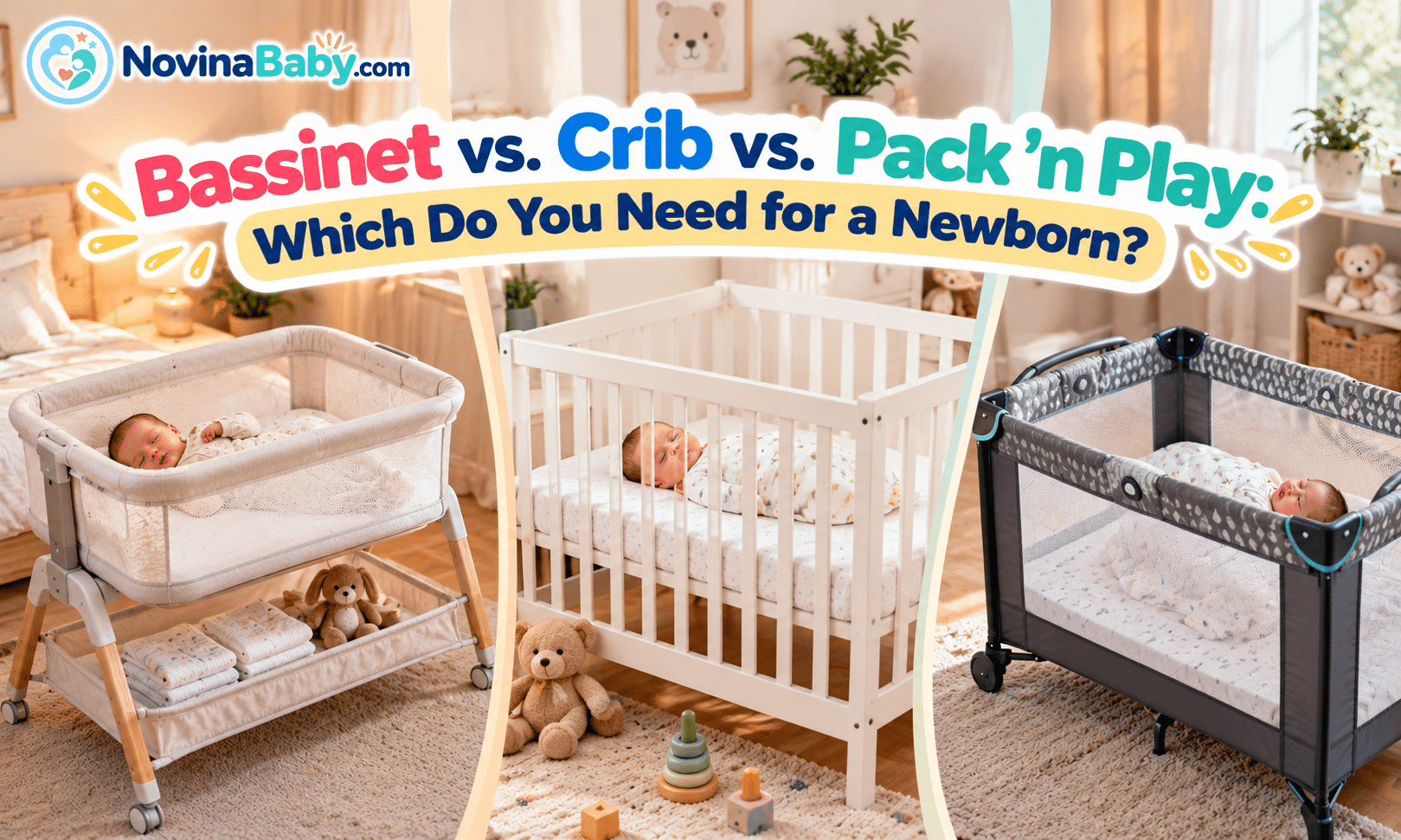
Bassinet vs. Crib for a Newborn – When you start building your baby registry, the sleep category quickly becomes a battleground of conflicting advice. One friend tells you to skip the bassinet entirely and put the baby straight into a full-size crib. Another swears their newborn slept exclusively in a Graco Pack ‘n Play for six months, while your obstetrician emphasizes keeping the baby within arm’s reach of your bed.
No parent wants to waste hundreds of dollars on redundant furniture that gathers dust in a hallway. Yet, when you are healing from childbirth and waking up every two hours to feed a crying infant, having the wrong sleep setup in your bedroom is physically exhausting.
In the debate of bassinet vs crib for a newborn—and where the multi-purpose Pack ‘n Play fits in—the secret lies in understanding how each piece is engineered for your physical recovery, your bedroom square footage, and your baby’s developmental stages.
All three options are 100% medically safe for overnight newborn sleep when used correctly. Let’s compare their exact specifications, CPSC safety certifications, and real-world pros and cons so you can invest in the right combination for your home.
Quick Comparison Matrix: Bassinet vs. Crib vs. Pack ‘n Play
Before diving into the nuances of midnight feedings and mattress heights, here is how the three CPSC-approved sleep surfaces stack up head-to-head.
| Feature / Metric | Baby Bassinet | Full-Size Crib | Pack ‘n Play (Play Yard) |
|---|---|---|---|
| Typical Age & Weight Limit | 0 to 4–6 months (15–20 lbs; stops when rolling begins) | Birth to 3+ years (up to 35 inches tall or 50 lbs in toddler mode) | 0–15 lbs (top bassinet insert); up to 30 lbs / 35″ (bottom floor) |
| Average Footprint | Compact (~32″ L x 20″ W); fits tight bedside spaces | Large (52″ L x 28″ W); rarely fits in master bedrooms | Medium (40″ L x 28.5″ W); foldable for storage & travel |
| Postpartum Back Strain | Minimal (Eye-level & swivel access from bed) | Moderate (Requires standing & leaning over wooden rails) | High on bottom level (Requires deep bending to floor level) |
| Federal Safety Standard | 16 CFR Part 1218 / ASTM F2194 | 16 CFR Part 1219 / ASTM F1169 | 16 CFR Part 1221 / ASTM F406 |
| Typical Price Range | $80 – $300 ($1,600+ for smart models) | $180 – $600+ (Mattress sold separately) | $70 – $300 (Includes folding pad) |
1. The Baby Bassinet: The Newborn & Postpartum Specialist
A bassinet is a compact, elevated infant bed engineered specifically for the “Fourth Trimester” (the first 3 to 5 months of life). Because the American Academy of Pediatrics advises that babies sleep in their parents’ bedroom for at least the first six months—a critical topic we cover in our guide to understanding AAP safe sleep guidelines—the bassinet was invented to make room-sharing effortless without taking up your entire master bedroom.
Why Parents Love It for the First 4 Months
After nine months of being tightly curled inside the womb, newborns often feel overwhelmed in wide-open spaces. A bassinet provides a cozy, oval or rectangular micro-environment with 360-degree breathable mesh walls that promote airflow while keeping your baby right at eye level next to your pillow.
Furthermore, modern bassinets are designed around maternal recovery. Specialized models like the Halo BassiNest Swivel Sleeper feature low-profile feet that tuck directly under your bed frame and a basket that rotates 360 degrees over your mattress, while high-tech options like the Snoo Smart Sleeper use gentle motion and white noise to soothe fussy newborns back to sleep.
The Pros of a Bassinet 👍
|
The Cons of a Bassinet 👎
|
If you are recovering from a surgical delivery or want a drop-wall design that anchors flush against your mattress, be sure to read our comparison of a bedside sleeper vs traditional bassinet to see which frame style fits your bed height.
2. The Full-Size (or Mini) Crib: The Long-Term Nursery Anchor
When weighing a bassinet vs crib for a newborn, many minimalist parents ask a logical question: “Can a newborn sleep in a full-size crib from the day they come home from the hospital?”
Medically and legally, the answer is yes. In fact, full-size cribs are held to the strictest federal safety regulations in the juvenile industry (16 CFR Part 1219). A convertible crib—such as the Graco Benton 5-in-1—is designed with an adjustable mattress support base. For a newborn, you install the mattress on the highest notch so you don’t have to bend all the way down, and as your baby learns to sit and stand, you lower the mattress toward the floor.
Why Most Parents Still Wait Until Month 4 to Use the Crib
If cribs are safe from birth, why don’t all parents skip the bassinet and use the crib immediately? It comes down to two practical obstacles: doorframes and nocturnal exhaustion.
A standard full-size crib measures roughly 54 inches long by 30 inches wide on the outside. Once assembled in the nursery, it will not fit through a standard bedroom doorway without being disassembled with an Allen wrench. Furthermore, most master bedrooms simply do not have the floor space for a full-size crib next to a Queen or King bed.
If your crib is down the hall in the nursery, you will have to get out of bed and walk across the house 4 to 6 times every single night during the newborn cluster-feeding phase. (One clever workaround for tight bedrooms is a GREENGUARD Gold certified mini crib on wheels, like the Babyletto Gelato 4-in-1, which has a smaller 38″ x 24″ footprint).
The Pros of a Crib 👍
|
The Cons of a Crib 👎
|
3. The Pack ‘n Play (Play Yard): The Multi-Tasking Workhorse
While parents use “Pack ‘n Play” as a catch-all phrase (thanks to the iconic Graco Pack ‘n Play Portable), the CPSC officially regulates these foldable mesh beds as Play Yards or Travel Cribs (a category that also includes ultra-lightweight travelers like the Guava Family Lotus Travel Crib).
Can a newborn sleep in a Pack ‘n Play overnight every single night instead of a bassinet or crib? Yes—provided you use the correct attachment.
🚨 CRITICAL SAFETY DISTINCTION: “Bassinet Insert” vs. “Napper”
Many multi-functional Pack ‘n Plays come with several clip-on accessories in the box, and mixing them up is dangerous:
- ✅ The Elevated Bassinet Insert (SAFE for Overnight Sleep): This is a full-size, completely flat mesh sling that clips over the top rails of the play yard and holds the flat folding mattress pad at waist height. It is CPSC-certified for overnight newborn sleep up to 15 lbs (or until the baby pushes up on hands and knees).
- ❌ Clip-On “Nappers,” Loungers, or Rockers (UNSAFE for Sleep): Some play yards include a small, plush, inclined cradle or changing station that clips onto the top. Because these accessories are inclined or softly padded, they are never safe for unsupervised or overnight sleep due to positional asphyxiation risks.
Once your baby outgrows the 15-pound top bassinet insert, you simply unclip the sling and drop the mattress pad down to the bottom floor of the Pack ‘n Play, where they can safely sleep and play until they reach 35 inches tall.
The Pros of a Pack ‘n Play 👍
|
The Cons of a Pack ‘n Play 👎
|
Which Setup Should You Choose? (4 Real-Life Scenarios)
Still torn on the bassinet vs crib for a newborn decision? Find the home and lifestyle profile below that matches your family.
🏥 Scenario 1: C-Section Recovery or Frequent Night Nursing
Your Best Move: Bedside Bassinet (Months 0–4) + Nursery Crib (Months 4+). When your abdominal muscles are healing, twisting out of bed and bending over a Pack ‘n Play or crib eight times a night is painful. A swivel or drop-wall bedside bassinet keeps your newborn level with your mattress for effortless midnight transfers, and once they start rolling around 4 months, you transition your baby from bassinet to crib in the nursery.
💰 Scenario 2: The Strict Budget or Minimalist Registry
Your Best Move: Pack ‘n Play with Bassinet Insert (Months 0–6) + Full-Size Crib. If you want to save $200 by skipping a dedicated bassinet, buy a portable Pack ‘n Play or travel crib that includes a flat, clip-on newborn bassinet sling. Use it in your master bedroom for the first 6 months to fulfill the AAP room-sharing rule, then keep it in your closet for family vacations once your baby moves to their wooden crib.
🏢 Scenario 3: Small 1-Bedroom Apartment
Your Best Move: Wheeled Mini Crib or Compact Bassinet. When square footage is tight, a full-size crib dominates the room. Start with a narrow bedside bassinet (under 20 inches wide) or invest in a 4-in-1 mini crib on casters that can roll effortlessly between the bedroom at night and the living room during the day.
🏠 Scenario 4: Two-Story Home (Upstairs & Downstairs Zones)
Your Best Move: Bedside Bassinet Upstairs + Pack ‘n Play Downstairs. Carrying a newborn up and down the stairs six times a day for naps and diaper changes gets old fast. Keep a dedicated bedside bassinet in your upstairs master bedroom for overnight sleep, and station a Pack ‘n Play with a wipeable changing attachment in your downstairs living room as a daytime command center.
A Crucial CPSC Warning About Supplemental Mattresses
One of the most common reasons parents hesitate to use a bassinet or a Pack ‘n Play for overnight sleep is that the included mattress pad feels remarkably thin—typically only 0.75 to 1.5 inches thick. Well-meaning grandparents often touch the pad, declare it “hard as a rock,” and urge you to buy a thicker 3-inch foam mattress on Amazon to drop inside.
Never add a supplemental aftermarket mattress to a bassinet or a Pack ‘n Play.
Unlike a wooden crib with rigid slats, bassinets and play yards have flexible mesh sides that stretch outward under pressure. If you put a thick, pillowy mattress inside a flexible mesh frame, a baby can roll into the corner, push the mesh outward, and get their face wedged in the gap between the thick mattress edge and the mesh wall.
The CPSC limits bassinet and play yard pad thickness specifically to prevent this fatal wedging hazard. As we explain in our guide to bassinet mattress pad and sheet safety, lightweight newborns (7 to 18 pounds) do not exert enough downward pressure to feel uncomfortable on a thin, firm pad. Only use the original pad provided by the manufacturer alongside tightly fitted sheets designed for those exact dimensions.
Bassinet vs. Crib for a Newborn (FAQ)
Is it safe for a newborn to sleep in a Pack ‘n Play every night?
Yes, 100%. Play yards (including Graco Pack ‘n Plays) meet strict federal CPSC safety requirements (16 CFR Part 1221) for unsupervised overnight sleep. Just ensure you are placing your newborn on either the flat, full-size elevated bassinet insert or the bottom floor level—never inside an inclined clip-on napper or changer—with only a tight-fitting playard sheet.
Why do newborns often sleep better in a bassinet than a full-size crib?
During the first three months, newborns have a strong Moro (startle) reflex and are accustomed to the snug boundary of the womb. The smaller perimeter of a bassinet, combined with being right next to the soothing sounds and scent of a sleeping parent, helps regulate a newborn’s breathing and arousal cycles better than a vast, quiet crib across the hall.
When must I remove the elevated bassinet insert from a Pack ‘n Play?
Almost all elevated play yard bassinet inserts have a strict 15-pound weight limit and must be removed the moment your baby begins rolling over or pushing up on their hands and knees (typically around 3 to 4 months). Once they hit that milestone, remove the clip-on sling and place the mattress pad on the bottom floor of the play yard.
Should I buy a bassinet first and wait to buy the crib until my baby is 3 months old?
Yes, many parents do exactly this to spread out expenses or save space before moving apartments! Because your baby will safely sleep in a bedside bassinet for their first 3 to 5 months, you do not technically need the nursery crib assembled on day one—though assembling heavy furniture before the baby arrives is often easier when you aren’t sleep-deprived.
Make Your First 5 Months of Night Feeds Effortless
While a crib is your long-term nursery anchor, nothing beats a dedicated bedside bassinet for surviving the exhausting newborn stage and healing comfortably in your own bed. We have evaluated the top CPSC-certified swivel sleepers, drop-side co-sleepers, and smart bassinets to help you find the safest fit for your bedroom and budget.