
🛡️ SIDS Prevention Standards
📅 Updated for 2026
AAP Safe Sleep Guidelines Bassinet – At 3:00 AM, when you are operating on ninety minutes of broken sleep and your newborn refuses to settle, bringing your baby into your warm adult bed feels like the most natural instinct in the world. You just want two uninterrupted hours of rest, and your baby immediately stops crying the moment they feel your body heat.
Every new parent faces this exhausting crossroads. However, understanding what happens biologically when a newborn sleeps on an adult mattress versus a dedicated infant sleep surface is one of the most important safety lessons of early parenthood.
Much of the confusion stems from the blanket term “co-sleeping.” Friends, social media influencers, and even family members often use “co-sleeping” to describe both sleeping in the same bed and sleeping in the same room.
In pediatric medicine, those two practices could not be more different. Following the official AAP safe sleep guidelines for a bassinet allows you to keep your baby right at your fingertips all night long while cutting the risk of sleep-related infant deaths in half.
Let’s break down the foundational “ABCs” of infant sleep, compare the clinical data on room-sharing versus bed-sharing, and show you how to set up a bedside sleep sanctuary that protects both your baby’s airway and your sanity.
The Core Foundation: What Are the “ABCs” of Safe Sleep?
Around 3,500 infants in the United States die suddenly and unexpectedly every year during sleep due to Sudden Unexpected Infant Death (SUID), which includes SIDS and accidental suffocation. To make medical prevention easy for sleep-deprived parents to remember, the AAP and CDC distill the primary safety protocols into three letters: A, B, and C.
🅰️ A is for ALONE (On Their Own Surface, With Zero Clutter)
“Alone” does not mean your baby should be isolated in a separate room down the hall. It means your baby must be the only person on their specific sleep surface, and that surface must be completely bare.
There should be zero pillows, loose blankets, stuffed animals, burp cloths, or padded bumper pads inside the sleep area. Even if you are sleeping twins, the AAP advises that each baby should have their own separate bassinet or crib to prevent one infant from rolling into and obstructing the breathing of the other.
🅱️ B is for BACK (For Every Nap and Every Night)
Until their first birthday, babies must always be placed to sleep flat on their backs—never on their stomachs or their sides. Side sleeping is unstable because newborns easily roll forward from their side onto their stomach.
What if my baby spits up on their back? Many parents fear a baby will choke if they spit up while lying flat on their back. Anatomically, the opposite is true. When a baby lies on their back, the windpipe (trachea) sits on top of the food pipe (esophagus). Anything regurgitated has to fight gravity to enter the lungs, so the baby naturally swallows it back down or coughs it out.
🅲 C is for CRIB or BASSINET (Firm, Flat, and CPSC-Certified)
Your baby must sleep in a safety-tested, CPSC-approved bassinet, bedside sleeper, play yard (Pack ‘n Play), or crib. The mattress pad inside must be exceptionally firm and completely flat, covered only by a tightly fitted sheet.
Adults love sinking into plush memory foam, but for an infant, softness is deadly. If a baby turns their face into a soft surface, the material contours around their nose and mouth, creating a pocket of stagnant air where they rebreathe their own carbon dioxide. If you aren’t sure which sleep piece to buy first, read our full breakdown of bassinet vs crib vs Pack ‘n Play for newborns.
Room-Sharing vs. Bed-Sharing: The Critical Difference
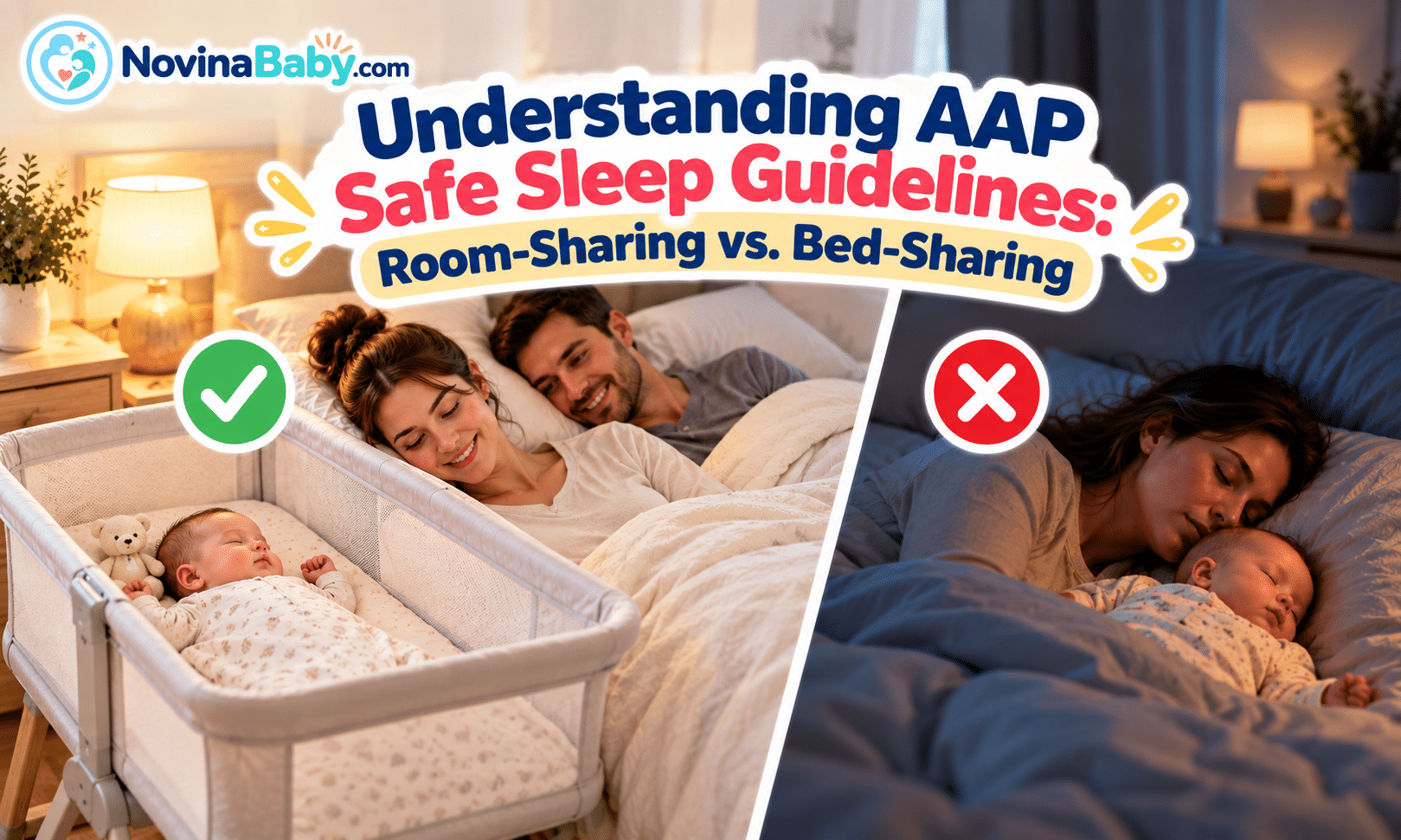
To follow the AAP safe sleep guidelines for a bassinet, you must separate the concept of proximity from the concept of sharing a mattress. The AAP strongly endorses room-sharing while advising against bed-sharing under any circumstances.
Why Room-Sharing Cuts SIDS Risk by Up to 50%
Room-sharing means placing your baby’s bassinet, portable crib, or bedside sleeper right next to your bed in the master bedroom for at least the first 6 months (and ideally up to 12 months). The first six months are critical because 90% of SIDS cases occur before a baby turns six months old, peaking between 1 and 4 months of age.
When your baby sleeps a few feet away from you in a bassinet, your subtle breathing sounds and movements help regulate their immature nervous system, preventing them from falling into an abnormally deep arousal threshold. At the same time, you can hear early hunger cues (like lip-smacking or rooting) and feed them before they start hysterically crying.
Why Adult Beds Are Mechanically Unsafe for Infants
Bed-sharing (or surface-sharing) means bringing the baby onto an adult mattress, sofa, or recliner to sleep alongside a parent. Even if you strip all the blankets off your bed and follow popular internet “Safe Sleep 7” checklists, an adult bed still fails mechanical infant safety tests for five reasons:
- Adult Mattresses Are Too Soft: Even the “firmest” orthopedic adult mattress is engineered with a comfort top layer that indents under weight, creating a positional suffocation hazard if a baby rolls onto their stomach.
- The “Trough” Effect: An adult’s heavy body weight creates a dip or slope in the mattress. A lightweight newborn lying nearby will naturally roll down that invisible slope directly against the parent’s warm torso or beneath their arm.
- Entrapment Gaps: Adult headboards, footboards, and walls are not regulated by the CPSC’s strict two-finger gap rule. Babies can easily wiggle into the crevice between an adult mattress and the wall or nightstand and become wedged.
- Thermal Overheating: Sleeping pressed against an adult’s 98.6°F body—especially under a shared duvet—causes rapid overheating, which is one of the strongest physiological triggers for SIDS.
- Extreme Risk Factors: According to the AAP, the risk of infant death increases more than 10-fold when bed-sharing with an infant under 4 months old, a premature or low-birth-weight baby, or a parent who is severely sleep-deprived, taking sedating medications, or sleeping on a couch/armchair.
| Safety Factor | Room-Sharing (Bedside Bassinet) | Bed-Sharing (Adult Mattress) |
|---|---|---|
| AAP & CDC Verdict | ✅ Strongly Recommended (0–6+ Months) | ❌ Strictly Advised Against |
| SIDS & Suffocation Impact | Decreases SIDS risk by up to 50%. | Increases suffocation & SUID risk by 5x to 10x. |
| Surface Firmness | CPSC-tested ultra-firm, flat pad; zero indentation. | Plush pillow-tops and memory foam contour around the face. |
| Perimeter Walls | 360-degree breathable mesh walls prevent entrapment. | Open edges (fall risk) and headboard gaps (wedging hazard). |
| 3:00 AM Feeding Access | Within arm’s reach (swivel or drop-wall access). | Immediate access, but high risk of parent falling asleep mid-feed. |
Critical CPSC & AAP Rules: Inclines and In-Bed Loungers
In recent years, federal regulators and the AAP tightened the rules around infant sleep products after investigating hundreds of tragedies linked to trendy nursery gear. When applying the AAP safe sleep guidelines to a bassinet, you must watch out for two major traps:
🚫 1. The 10-Degree Rule (Why Inclined Sleepers Are Banned)
Under federal CPSC regulations and the Safe Sleep for Babies Act, any product marketed for infant sleep must have an angle of 10 degrees or less—meaning it must be virtually flat. Even if your baby suffers from gastroesophageal reflux (spit-up), elevating the head of the bassinet with books, wedges, or built-in inclines is ineffective and dangerous.
Newborns have heavy heads and weak neck muscles. On an incline greater than 10 degrees, a baby’s head easily slumps forward so their chin presses into their chest. This silently kinks their tiny windpipe like a bent garden hose, leading to positional asphyxiation within minutes without a single cry.
2. Why “In-Bed Sleepers” and Padded Loungers Are Not Bassinets
Many parents try to compromise on bed-sharing by placing a padded fabric nest, pod, or infant lounger right in the middle of the adult bed between mom and dad. The AAP specifically warns against these “in-bed sleepers.”
Padded fabric loungers have thick, pillow-like bolsters around the perimeter that fail breathability standards. Instead, if you want your baby right next to your pillow—especially while healing from a C-section—choose a CPSC-certified standalone bedside sleeper (such as the Halo BassiNest Swivel Sleeper or a drop-side co-sleeper that locks securely beside the adult frame). We break down the exact mechanical differences in our comparison of a bedside sleeper vs traditional bassinet.
5 Golden Rules for Setting Up a Safe Bedside Bassinet
Buying a CPSC-certified bassinet is step one; setting it up properly in your bedroom is step two. Follow this 5-point safety checklist every single night to avoid common bassinet safety mistakes:
- Enforce the 3-Foot Cord & Curtain Zone: Place the bassinet away from window blind cords, drapery panels, and electrical wires. If you mount a smart baby monitor camera or place a white noise machine nearby, ensure all power cords are secured at least 3 feet away from the edge of the bassinet to eliminate strangulation hazards.
- Never Add an Aftermarket Mattress: The thin 1-inch pad that comes with your bassinet feels hard to your adult hand on purpose. Never buy a thicker, third-party foam mattress to put inside a bassinet, as it creates dangerous entrapment gaps along the mesh walls.
- Use Swaddles or Wearable Blankets Instead of Loose Covers: Keep your bedroom cool—ideally between 68°F and 72°F (20°C–22°C)—and dress your baby in one breathable layer plus a snug Velcro swaddle or wearable sleep sack. Avoid weighted swaddles or weighted sleep sacks, which the AAP warns against because they restrict a newborn’s chest expansion.
- Nurse in Bed, But Always Return Baby to the Bassinet: If you bring your baby into your bed to breastfeed or bottle-feed at night, clear your immediate area of heavy pillows and blankets first in case you accidentally doze off. As soon as you finish feeding (or if you feel yourself drifting to sleep), slide your baby right back into their adjacent bassinet. Never feed a sleepy baby on a couch or plush armchair, where the risk of wedging between cushions is extraordinarily high.
- Know When to Graduate to a Crib: A bassinet is only safe while your baby is immobile. The exact day your baby begins rolling over, pushing up on their hands, or hitting the manufacturer’s weight limit (usually 15–20 lbs), you must stop swaddling their arms and move them out. Read our full guide on when and how to transition your baby from bassinet to crib, and pair their next bed with one of our top-rated breathable crib mattresses.
AAP Safe Sleep Guidelines Bassinet (FAQ)
Why did the AAP change the room-sharing recommendation from 1 year to 6 months?
In its updated safe sleep policy, the AAP states that parents should room-share for at least the first 6 months, and ideally up to a year. Pediatric researchers emphasized the first 6 months because more than 90% of SIDS deaths occur during that initial six-month window, and keeping the goal realistic encourages more exhausted parents to comply during the highest-risk period.
Does offering a pacifier in the bassinet really help prevent SIDS?
Yes! The AAP strongly recommends offering a dry pacifier at naptime and bedtime once breastfeeding is well-established (usually around 3 to 4 weeks old). Sucking on a pacifier keeps a baby’s airway open and maintains a lighter arousal state. If the pacifier falls out of their mouth after they fall asleep, you do not need to put it back in—and never attach a pacifier to a clip, ribbon, or stuffed animal inside the bassinet.
Are bedside sleepers with a drop-down mesh wall approved by the AAP?
Yes, provided they meet the federal CPSC safety standard for “Bedside Sleepers” (ASTM F2906). A certified bedside sleeper always retains a low fabric/mesh barrier wall (at least 4 inches high) on the drop side to prevent the baby from rolling onto the adult mattress, and includes heavy-duty anchor straps or a cantilever base that locks flush against the adult bed without leaving a gap.
Can I put a hat on my newborn while they sleep in the bassinet?
No. Once you return home from the hospital, the AAP advises against putting hats or beanies on a sleeping baby indoors. Babies release the vast majority of their excess body heat through their heads, so wearing a hat while sleeping can cause dangerous overheating—and if the hat slips down over their nose, it becomes an immediate suffocation hazard.
Keep Your Baby Close—Without the Risks of Bed-Sharing
Following the AAP room-sharing guidelines is effortless when you have a bassinet that swivels right over your mattress or locks safely beside your bed. We have rigorously evaluated the top CPSC-certified bassinets and bedside sleepers for 360-degree mesh breathability, mattress firmness, and 3:00 AM feeding accessibility.