
🤖 Tech & Safety Evaluated
📅 Updated for 2026
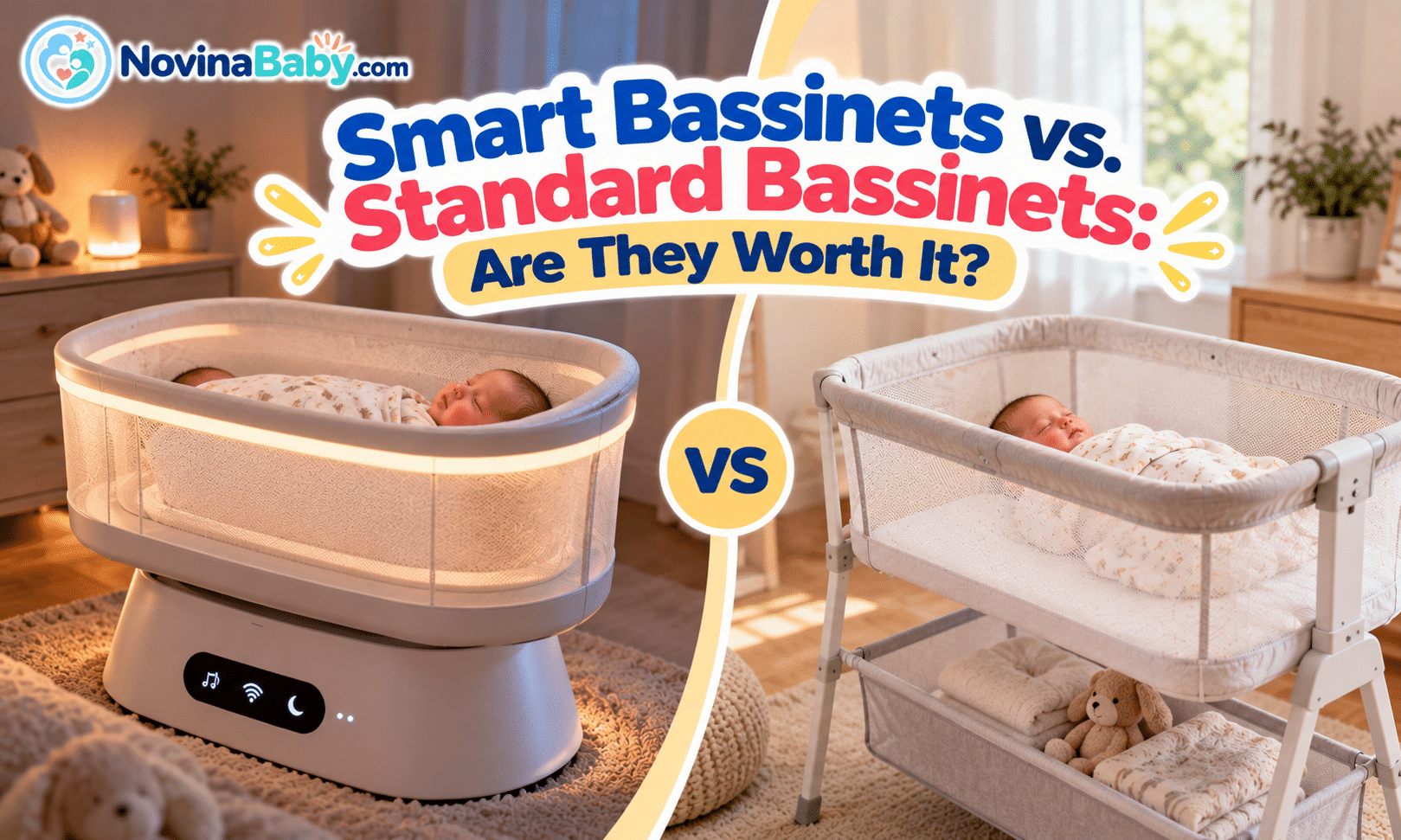
Smart Bassinets vs. Standard Bassinets – When you start researching baby sleep gear, you will eventually stumble across a piece of nursery technology that looks like it belongs in a sci-fi movie. Automated robotic bassinets—most notably the Snoo Smart Sleeper—feature built-in white noise machines, internal microphones that detect baby cries, and computerized motors that dynamically increase rocking speeds the moment your baby stirs.
They also come with a jaw-dropping price tag: upwards of $1,600 to $1,700 retail (though rental programs run around $150 per month).
For a piece of furniture your baby will outgrow in less than five months, that investment forces every parent to pause and ask: Are smart bassinets actually worth the money? Or is a traditional, stationary mesh bassinet for $150 just as effective at helping your baby sleep?
To answer this honestly, we have to look past the marketing hype and examine the actual data on infant sleep cycles, the mechanics of automated soothing, and the brutal reality of the 4-to-5-month expiration date.
Quick Comparison Matrix: Smart vs. Standard vs. Rocking Bassinets
Before breaking down the financial math, here is how smart robotic sleepers compare directly to manual rocking bassinets and traditional stationary models.
| Feature / Metric | Smart Robotic Bassinet (e.g., Snoo) | Manual Rocking / Gliding Bassinet | Standard Stationary Bassinet |
|---|---|---|---|
| Soothing Mechanism | Automated responsive motion & white noise reacting to baby’s cries via mic sensors. | Parent-powered manual rocking, foot-pedal gliding, or gentle push-sway. | Completely stationary frame; zero movement unless physically carried. |
| Swaddle Requirement | Strictly requires clipping the baby into a proprietary attached swaddle to prevent rolling. | Compatible with any standard AAP-safe swaddle or wearable sleep sack. | Compatible with any standard AAP-safe swaddle or wearable sleep sack. |
| Average Price Range | $1,500 – $1,700 (or ~$150/mo rental subscription) | $130 – $300 | $80 – $200 |
| Lifespan & Weight Limit | ~4 to 6 months (Max 25 lbs or when baby gets on hands/knees). | ~4 to 5 months (Max 15–20 lbs / rolling milestone). | ~4 to 5 months (Max 15–20 lbs / rolling milestone). |
| Resale Value | Exceptionally High (Retains 50%–70% value on marketplace). | Moderate ($40 – $80 resale). | Low to Moderate. |
1. The Smart Bassinet Promise: How Robotic Sleepers Work
To understand the high cost, you have to look at what smart sleepers are engineered to solve. When a newborn wakes up at 3:00 AM, they rarely transition smoothly back to sleep on their own. They fuss, grunt, and cry, requiring a parent to get out of bed, pick them up, rock them for ten minutes, and gently lower them back down.
Smart bassinets act as an electronic surrogate rock-and-shusher. For example, when the Snoo detects a fussing baby via built-in microphones:
- Immediate Sensory Escalation: It automatically ramps up white noise volume and increases the rhythmic lateral rocking motion from a gentle sway to a faster, firmer wiggle.
- The “Catch” Effect: By intervening within seconds of the baby stirring during a light sleep cycle (REM transition), the motion often successfully lulls the baby back to sleep before they ever fully wake up crying.
- The Safety Lock (Swaddle Clips): Because the bassinet moves autonomously, the baby must be physically clipped into a specialized wing-swaddle attached to the mattress. This ensures the baby cannot shift positions, roll over, or slide against the mesh walls while the motor is running.
The Pros of Smart Bassinets 👍
|
The Cons of Smart Bassinets 👎
|
2. Standard and Manual Rocking Bassinets: The Reliable Classics
If a smart robotic sleeper feels like an excessive financial stretch, a standard or manual rocking bassinet offers a middle ground. These units provide a safe, cozy, CPSC-certified sleep environment right beside your bed without reliance on smartphone apps, electrical cords, or motorized algorithms.
Manual rocking bassinets—such as the 4moms mamaRoo Sleep Bassinet (which offers manual or multi-speed vertical/lateral adjustments) or classic gliding baskets—let you gently rock your baby with a quick push of your hand or foot while lying in bed.
The Pros of Standard/Manual Bassinets 👍
|
The Cons of Standard/Manual Bassinets 👎
|
The Financial Math: Cost-Per-Hour of Sleep
When evaluating whether smart bassinets are worth the money, you have to look at the cold, hard economic math of the newborn window.
Let’s assume your baby uses a smart bassinet for 120 nights (roughly 4 months) before outgrowing it. If you purchase a Snoo outright for $1,650, you are paying roughly $13.75 per night. If you use a monthly rental program at $150/month for 4 months ($600 total), your cost drops to $5.00 per night.
Compare that to a standard $150 bedside bassinet (like the Halo or Mika Micky) used for 120 nights, which breaks down to just $1.25 per night.
💡 The Verdict on “Worth It”
Are smart bassinets worth it? Yes, if your budget allows for it and parental sleep deprivation is your single greatest health risk. For working parents who must function in high-cognitive professional roles within weeks of childbirth, gaining an extra 90 minutes of sleep per night is priceless.
However, if $1,500 causes financial stress on your family registry, skip the robotic motors. A standard, CPSC-certified bedside bassinet paired with a separate white noise machine (like the Hatch Rest) will keep your baby just as safe while saving you over $1,300.
Safety Checklist: What to Look For When Buying Any Bassinet
Regardless of whether you choose a high-tech robotic sleeper or a standard manual bassinet, never compromise on these federal CPSC safety rules:
- CPSC & ASTM Certification: Ensure the model meets current federal standards (ASTM F2194 for bassinets). Avoid uncertified vintage hand-me-down bassinets from garage sales.
- 360-Degree Breathable Mesh: The perimeter walls must be made of sturdy, open-weave mesh to ensure maximum airflow even if a baby presses their face against the side.
- Firm, Flat Mattress Pad: The mattress must be exceptionally firm and flat (meeting the 10-degree maximum incline rule). Never add plush pads or pillows.
- Know the Expiration Date: Remember that all bassinets—smart or standard—have a strict lifespan. The moment your baby begins rolling over, pushing up on their hands and knees, or hits the weight limit, you must transition your baby from bassinet to crib.
Smart Bassinets vs. Standard Bassinets (FAQ)
Do smart bassinets prevent SIDS?
While smart bassinets like the Snoo use secure swaddle clips to ensure babies stay flat on their backs during motion, neither the AAP nor the CPSC states that any bassinet can actively prevent SIDS. They provide a safe sleep surface, but SIDS prevention relies on following the foundational ABCs of safe sleep (Alone, Back, Crib/Bassinet).
Is it hard to transition a baby out of a smart rocking bassinet into a stationary crib?
Some parents experience a brief 2-to-3-night adjustment period when moving a baby from a rocking smart bassinet into a stationary crib. To make this easier, premium smart bassinets include a “Weaning Mode” feature in their companion apps that turns off the motion while keeping the white noise active for a couple of weeks before you make the final room transfer.
Can I buy a used smart bassinet safely?
Yes, buying a used smart bassinet on Facebook Marketplace or eBay is a very popular way to cut the cost in half. However, always inspect the electronic motor, test the app connection, check for software updates, and purchase a brand-new mattress pad and fresh swaddle clips directly from the manufacturer for hygiene and safety.
What happens if my baby hates the rocking motion of a smart bassinet?
Some infants actually prefer a completely stationary sleep surface and become over-stimulated by constant movement. If you rent or buy a smart bassinet and your baby fusses more when the motor turns on, you can easily lock the motion off through the app and use it purely as a stationary bedside bassinet.
Find the Right Bassinet for Your Family’s Sleep Style
Whether you decide to invest in high-tech robotic soothing or prefer a reliable, beautifully crafted standard bedside bassinet, we have tested the top options for safety, breathability, and ease of use. Compare our rigorous ratings and find your ideal newborn sleep setup today.